
The Air in Oklahoma: Scientists Find Toxic ‘Replacement’ Chemicals for the First Time
A group of scientists from the University of Colorado Boulder recently set up some high-tech gear in a quiet part of north-central Oklahoma. They weren’t looking for trouble. They were actually trying to study how tiny bits of dust and particles move through the atmosphere. But as they looked at their data, they found something they didn’t expect. They picked up a chemical called Medium-Chain Chlorinated Paraffins—or MCCPs for short.
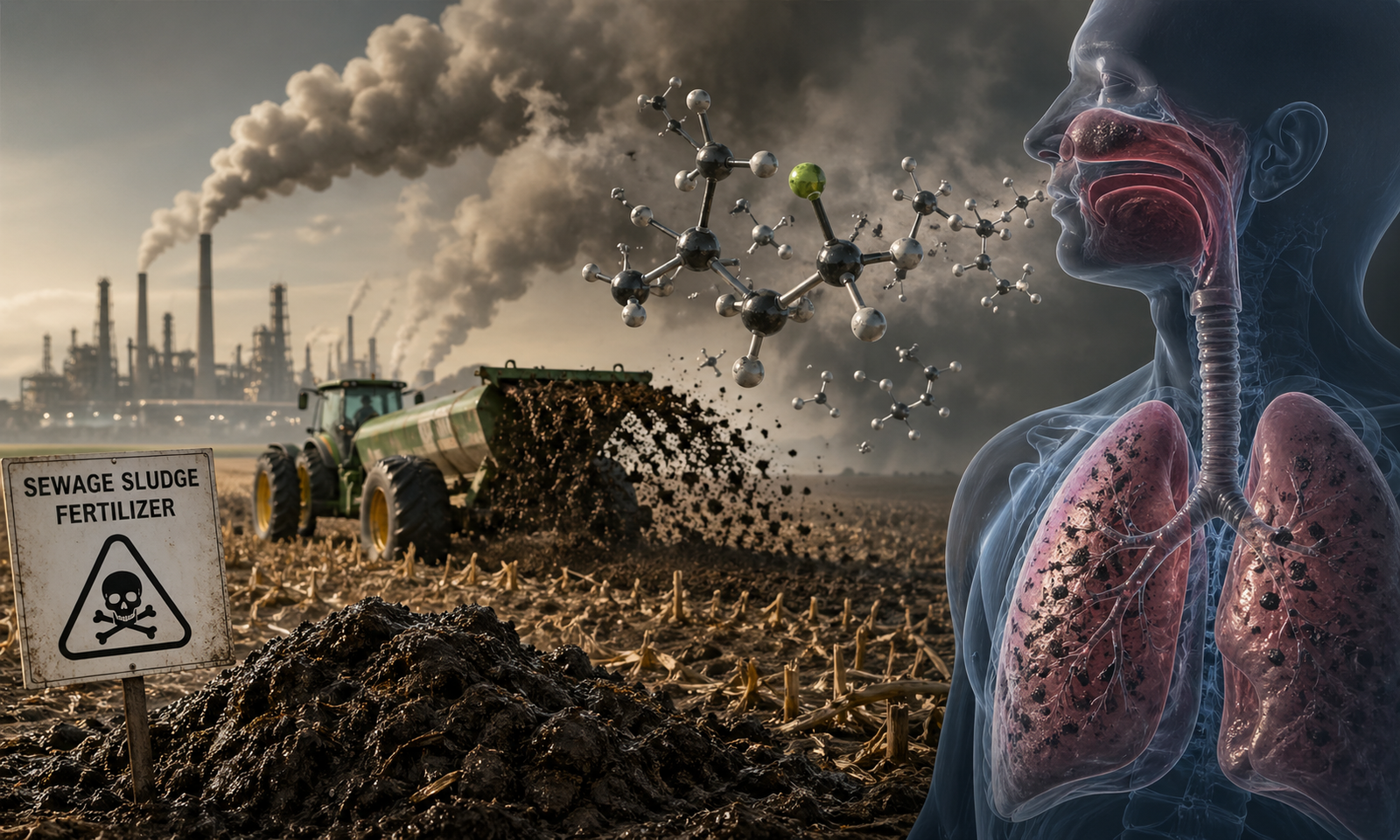
This was the first time anyone had ever detected this specific toxic chemical in the air over North America. It wasn’t coming from a massive factory chimney or a chemical spill. Instead, it seems to be rising directly from the ground—specifically from farm fields where “biosolid” fertilizer had been spread.
To put it plainly, we are taking industrial waste, turning it into fertilizer, and now that waste is literally evaporating into the air we breathe.
What are MCCPs and Why Should You Care?
You probably haven’t heard of MCCPs, but you use them every day. These chemicals are man-made. Manufacturers love them because they are incredibly versatile. They make PVC pipes flexible. They help metal-cutting tools stay cool. They act as flame retardants in plastics, rubber, and even some paints. If a product is plastic and bendy, or if it needs to survive high heat, there is a good chance MCCPs are involved.
The problem is that these chemicals are “persistent.” In the world of science, that means they don’t go away. They don’t break down when it rains. They don’t disappear in the sun. Once they get into the environment, they stay there for years, slowly moving up the food chain until they end up in animals and, eventually, people.
For a long time, the world used “Short-Chain” versions of these chemicals. When those were found to be incredibly toxic and likely to cause cancer, they were banned. The industry responded by switching to the “Medium-Chain” version, claiming they were a safer alternative. This discovery in Oklahoma proves that the “safe” alternative is now blanketing the landscape.
The Sewage Sludge Connection
Most people assume that when they flush the toilet or pour something down the drain, it just goes “away.” In reality, it goes to a wastewater treatment plant. These plants do a great job of cleaning the water, but all the solid gunk—the heavy metals, the industrial chemicals, and the human waste—has to go somewhere.
That leftover gunk is called sewage sludge. Because it’s expensive to bury it in a landfill, the industry came up with a clever rebranding: they called it “biosolids” and started selling it to farmers as a cheap, nutrient-rich fertilizer.
For decades, this has been sold as a win-win. Cities get rid of their waste, and farmers get cheap fertilizer. But this process ignores one massive flaw. The treatment plants aren’t designed to filter out industrial chemicals like MCCPs or PFAS (the “forever chemicals” you’ve probably heard about). So, these toxins stay in the sludge. When a farmer spreads that sludge over a field, they aren’t just adding nitrogen to the soil. They are coating the earth in a layer of industrial chemicals.
The research team in Oklahoma found that these chemicals don’t just sit in the dirt. They “volatilize.” This means they turn into a gas or hitch a ride on dust particles and float into the sky. If you live near a farm that uses these biosolids, you aren’t just eating food grown in this stuff—you are breathing it.
Why This is Happening in Oklahoma
The detection happened near a small town called Lamont. It’s a rural, agricultural area. There are no major chemical plants nearby. The fact that scientists found MCCPs here is a smoking gun. It suggests that the chemicals aren’t coming from a local factory, but are a byproduct of modern farming practices that use recycled waste.
Researchers believe the wind is picking up these chemicals from the fields and carrying them across the state. While the levels found in this specific study weren’t high enough to cause immediate, “fall-over-dead” toxicity, that misses the point. These are persistent chemicals. You don’t get sick from one breath. You get sick from breathing it every day for ten years.
The human body isn’t designed to process chlorinated paraffins. When they enter your system, they head straight for the liver and kidneys. They can disrupt your hormones and have been linked to cancer in lab studies. We are currently running a massive, uncontrolled experiment on the American public, and the early results aren’t good.
The Regulatory Game of Whac-A-Mole
The chemical industry is excellent at staying one step ahead of the law. This is often called “regrettable substitution.”
It works like this:
Government bans Chemical A because it’s toxic.
The industry slightly tweaks the molecule to create Chemical B.
Chemical B does the exact same job but isn’t technically banned yet.
Ten years later, scientists prove Chemical B is also toxic.
Government bans Chemical B.
Industry introduces Chemical C.
We saw this with BPA in plastic bottles being replaced by BPS, which turned out to be just as bad for hormones. We are seeing it now with MCCPs. The world finally realized that Short-Chain Chlorinated Paraffins (SCCPs) were a disaster for the planet and banned them globally under the Stockholm Convention. So, the industry just moved to the “Medium-Chain” version.
Now, the Stockholm Convention is finally catching up. In late 2025 and into 2026, international bodies have moved to ban MCCPs as well. They’ve realized there is no “safe” version of this chemical family. But because the US often lags behind international environmental treaties, these substances are still being manufactured and spread across our farmland.
Living Downwind of “Safe” Fertilizer
If you drive through the rural US in the spring, you might see trucks spreading a thick, dark material on the fields. It often has a distinct, pungent odor. Most people think it’s just manure. But if it’s biosolids, it’s a cocktail of everything that was in the city’s sewers.
Farmers are often victims in this story, too. Many are told that biosolids are a safe, “green” way to farm. They are given laboratory reports showing the “nutritional value” of the sludge. They aren’t told that their soil might become permanently contaminated with forever chemicals that could eventually make their land worthless or their crops unsellable.
In states like Maine, the contamination from these sludge fertilizers became so bad—poisoning milk and beef—that the state eventually banned the practice entirely. Oklahoma and other Midwestern states are now the new frontier for this toxic spread.
The Bigger Picture: Air Quality in 2026
We’ve spent the last forty years worried about what’s in our water. We worry about lead pipes and PFAS in our taps. But we have largely ignored the air, assuming that as long as we aren’t standing behind a bus exhaust, we are fine.
The Oklahoma study changes that. It shows that our air is becoming a repository for the chemicals we tried to “recycle” into the ground. When we put toxins in the soil, they don’t stay there. They move. They leach into the water table, and as we now know, they evaporate into the atmosphere.
This discovery coincides with a broader 2026 report from the Environmental Protection Network called “Terrible Toxics.” This report points out that federal safeguards for at least 12 major pollutants have been weakened or delayed. We are in a period where chemical production is going up, but our ability to track and stop these substances is being cut back.
The EPA has been trying to catch up by developing new ways to measure PFAS and other chemicals in the air, but the pace of industry is faster than the pace of regulation. For every one chemical the EPA manages to regulate, ten new ones hit the market.
Health Effects: What the Science Says
The danger of MCCPs isn’t just a theory. When these chemicals get into the environment, they accumulate in the fatty tissues of animals. If you eat meat or dairy from animals raised on land treated with sludge, you are ingesting these paraffins. If you live near the fields, you are breathing them.
Medical research has shown that high exposure to these compounds causes:
-
Liver Damage: The liver is the body’s filter. When it’s forced to deal with chlorinated paraffins, it becomes stressed, leading to inflammation and, eventually, permanent damage.
-
Kidney Stress: Like the liver, the kidneys struggle to clear these persistent man-made molecules.
-
Thyroid Disruption: These chemicals can mimic or interfere with your body’s natural hormones, leading to issues with metabolism and growth.
-
Cancer Risk: While more human studies are needed, the evidence from animal testing is strong enough that international agencies have labeled them as potential carcinogens.
The most frustrating part is that exposure is involuntary. You can choose not to buy a certain brand of plastic, but you cannot choose not to breathe the air in your neighborhood.
Why the “Biosolids” Rebrand Failed
The push to use sewage sludge as fertilizer was born out of a desire for “sustainability.” The idea was that we shouldn’t waste the nutrients in our waste. But you can’t have a “circular economy” if the circle is full of poison.
If we want to use waste as fertilizer, we have to stop putting industrial chemicals into the waste stream in the first place. You can’t filter these things out at a standard municipal water plant. The technology to do so would cost billions of dollars and send water bills through the roof.
The only real solution is to stop using these chemicals at the source. If we don’t need bendy PVC pipes or specific metal lubricants as much as we need clean air and safe soil, the choice should be easy. But the chemical lobby is powerful, and “biosolids” remain a massive industry.
The Economic Cost of Toxic Air
There is a massive hidden cost to this pollution. When a chemical like MCCP is found in the air, it’s not just a health crisis; it’s an economic one.
Think about the healthcare costs of treating chronic liver and kidney disease. Think about the loss of property value for homes located near fields that are literally off-gassing toxins. Think about the farmers who might find their land “retired” by the state because the soil is too toxic to grow food.
We are subsidizing the chemical industry by allowing them to dump their waste into our sewers, which then gets spread on our farms and evaporated into our air. The public pays the price in hospital bills and lost lives, while the companies that make the chemicals walk away with the profits.
Taking a Stance: It’s Time to Stop the Spread
We have to stop pretending that sewage sludge is a “natural” fertilizer. It is an industrial byproduct. Spreading it on farmland is just a slow-motion way of turning our food supply and our atmosphere into a landfill.
The discovery in Oklahoma should be a massive wake-up call. If a chemical that has never been seen before in North American air is suddenly floating over a quiet farm town, we have a systemic problem. It means our “safety” systems are failing.
We need to follow the lead of states like Maine and start placing heavy restrictions on the land application of biosolids. We also need to demand that the EPA stop the “Whac-A-Mole” game and start regulating entire classes of chemicals—like chlorinated paraffins—rather than waiting for each specific molecule to be proven deadly one by one.
What Happens Next?
The scientists in Boulder are going to keep monitoring the air. Now that they know what to look for, they will likely find MCCPs in other states, too. This isn’t just an Oklahoma problem; it’s a national one.
As more data comes in, the pressure on the government will grow. We are entering a phase where “forever chemicals” are no longer just a scary story about a distant factory. They are in our water, they are in our soil, and now, they are in the wind.
The transition to a cleaner environment isn’t just about carbon emissions or electric cars. It’s about the invisible chemistry of our daily lives. If we don’t get a handle on how we dispose of industrial waste, we are going to find that “away” doesn’t exist. Everything we flush or throw “away” eventually finds its way back to us—sometimes through the very air we breathe.
The 2026 findings are clear: the “replacement” chemicals are failing us. It’s time to stop looking for the next “safe” poison and start looking for ways to keep these toxins out of our world entirely.
The air in Oklahoma might be the first place we caught these chemicals, but it won’t be the last. The question is whether we will act now or wait until these paraffins are as common in our lungs as oxygen. The choice is ours, but the clock is ticking, and the wind is already blowing.