The 2026 Apple’s Next Chapter Leadership Shift: John Ternus Replaces Tim Cook as Apple CEO
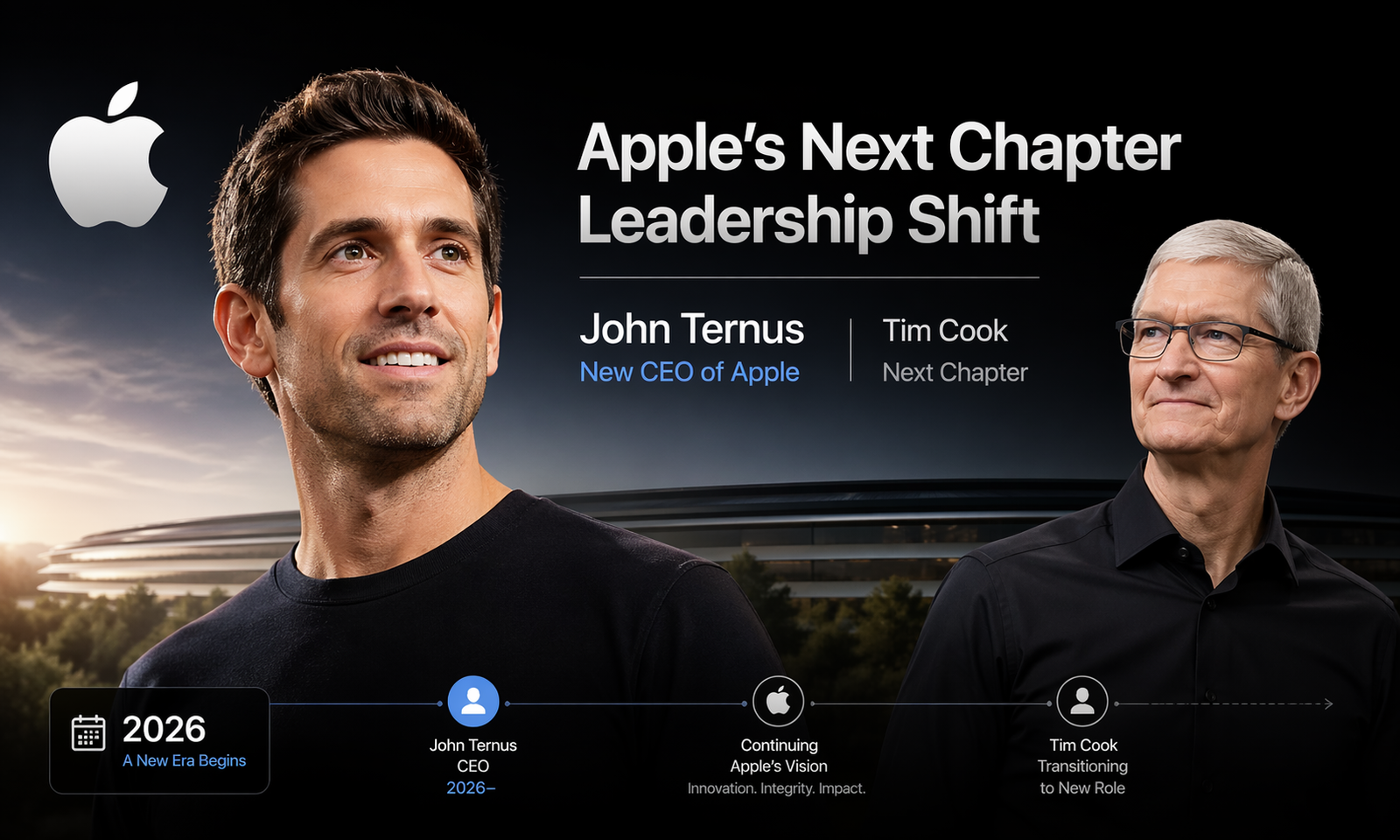
Apple announced on April 20, 2026, that John Ternus will become its new Chief Executive Officer. The transition takes effect on September 1, 2026. Tim Cook, the current CEO, will step down and assume the role of Executive Chairman of the board of directors. Ternus currently serves as the Senior Vice President of Hardware Engineering. The board of directors approved the transition unanimously. Johny Srouji will succeed Ternus as the chief hardware officer immediately.
Behind the scenes of Handover
The change in leadership was expected inside Cupertino. Cook is 65 years old and ran the company for 15 years. He secured Apple’s position as the most valuable corporation on earth. He built a massive user base of over 2.5 billion active devices. The choice of his successor answers a massive question about how Apple views its own future.
Ternus is only the third CEO of modern Apple. Steve Jobs was the founder and visionary. Tim Cook was the operations and supply chain master. Ternus is a pure hardware engineer. By handing the top job to the person who physically builds the devices, Apple is stating clearly that it intends to remain a toolmaker. Competitors are pivoting entirely to software and artificial intelligence services. Apple is doubling down on metal, glass, and local processing power.
The Engineer Takes the Control
Ternus was born in 1975. He attended the University of Pennsylvania and earned a bachelor’s degree in mechanical engineering. He spent his early career working at Virtual Research Systems before Apple hired him into its product design team in 2001.
He survived the intense, often brutal internal politics of the Steve Jobs era. He kept his head down and built a reputation for shipping products on time. In 2013, he earned a promotion to Vice President of Hardware Engineering. By 2021, he joined the top executive team as Senior Vice President.
Colleagues describe Ternus as measured and practical. His management style closely mirrors Cook’s approach. He does not yell. He does not seek the spotlight. He focuses entirely on physical constraints, thermal dynamics, and manufacturing yields. Apple chose internal continuity over an external hire because they value stability. They need a mechanic who understands the exact tolerances of their manufacturing lines.
Fixing the Mac and Inventing Apple Silicon
Ternus made his name by solving Apple’s biggest hardware crisis of the last decade. In the late 2010s, the Mac lineup was failing. The company relied on Intel to supply processors. Intel repeatedly delayed new chips. When the chips did ship, they ran incredibly hot. Apple designers insisted on building thin laptops, which resulted in terrible cooling systems. Laptops suffered from thermal throttling. Keyboards broke constantly. Professional users started abandoning the platform.
Ternus led the engineering teams that fixed the hardware. He did not just tweak the fan speeds. He executed a complete replacement of the computer’s brain. He managed the transition away from Intel to Apple’s proprietary M-series processors.
The M1 chip launched in 2020 and stunned the computer industry. Ternus delivered a fanless MacBook Air that outperformed expensive, power-hungry desktop towers. He managed the thermal layout, the battery allocation, and the physical logic board design. He proved he could manage massive risk across multiple product lines simultaneously. He recently oversaw the launch of the M4 and M5 processors, securing Apple’s lead in custom silicon.
Expanding the Hardware Footprint
Ternus oversaw the physical components of almost every major product released under Cook. He led the teams that built the modern iPad lineup. He pushed the AirPods from a mocked concept into a multibillion-dollar standalone business.
He also championed the Neo. Released as a budget-friendly laptop priced at $599, the Neo marked a massive shift in Apple’s strategy. For decades, Apple refused to sell cheap computers to protect its premium brand image. Ternus recognized a vulnerability. Schools were buying cheap Chromebooks. Students grew up using Google software. Apple risked losing a generation of future professionals. Ternus directed the engineering team to build a machine that felt like an Apple product but hit a strict budget. They utilized recycled manufacturing lines to lower costs while keeping the powerful M-series chip inside.
He also forced rigorous environmental standards onto the engineering process. Ternus mandated the use of a new recycled aluminum compound across multiple product lines. He pushed the adoption of 3D-printed titanium for the Apple Watch Ultra 3. He turned corporate environmental goals into physical manufacturing requirements.
The Artificial Intelligence Hurdle
Ternus inherits the top job right as the tech industry faces a severe power crisis. Artificial intelligence models require massive amounts of energy. Companies are building dedicated power plants just to cool the servers running language models.
Apple’s strategy runs counter to this trend. They want AI processing to happen directly on the phone or the laptop. This protects user privacy because data never leaves the device. It also works without an internet connection. However, running AI locally requires the hardware to do extreme heavy lifting without draining the battery or melting the casing.
This is exactly why Ternus is the CEO. His entire career is about cramming maximum performance into tiny spaces. The recent M4 and M5 processors feature massive neural engines designed specifically for local AI tasks. Ternus will spend his first year proving that Apple’s on-device AI approach is superior to the cloud-dependent models pushed by Google and OpenAI.
Tim Cook’s 15-Year Reign
To understand what Ternus inherits, you have to look at what Cook built. Tim Cook took over Apple in August 2011, just weeks before Steve Jobs died. The business press expected Apple to fade. Jobs provided the vision; Cook merely managed the factories.
Cook proved that execution matters just as much as vision. He inherited a company worth around $350 billion and turned it into a three-trillion-dollar empire. He did not launch as many entirely new product categories as Jobs. Instead, he mastered operations. He made the iPhone the most profitable consumer product in history by rigorously controlling the supply chain.
Cook expanded Apple into wearable technology. The Apple Watch launched in 2015. It completely dominates the global watch market today. AirPods followed in 2016 and changed consumer audio habits permanently.
He also built a massive services division. This includes Apple Music, iCloud, and the App Store. Services generate billions of dollars in recurring revenue every quarter. This predictable cash flow protected Apple’s stock price when consumers started holding onto their iPhones for four or five years instead of upgrading every two years.
The Privacy Shield
Cook’s most significant cultural contribution was his stance on privacy. In 2016, the FBI demanded Apple build a backdoor to unlock an iPhone used by a mass shooter in San Bernardino. The pressure was immense.
Cook refused. He published a public letter to customers arguing that building a backdoor for law enforcement inevitably creates a backdoor for criminals. The government eventually backed down. This standoff redefined Apple’s brand. Cook positioned privacy as a fundamental human right. He turned it into a blunt marketing weapon against competitors who rely on selling user data for targeted advertising. Apple sells hardware. They do not need to read user emails to make a profit. Cook hardwired this philosophy into the company’s software architecture.
Supply Chains and Geopolitics
Steve Jobs largely ignored the world outside California. Tim Cook operated like a head of state. He recognized early that Apple relied almost entirely on China for manufacturing. When trade wars erupted, Cook personally negotiated with global leaders to keep tariffs off Apple products.
He also recognized the danger of a single point of failure. Over his last five years as CEO, Cook systematically moved portions of Apple’s manufacturing to Vietnam and India. In 2023, he opened the first Apple retail stores in India, including Apple BKC in Mumbai. He treated India as a critical manufacturing hub and the company’s next massive consumer market.
As Executive Chairman, Cook will continue to handle this geopolitical strategy. The global market is heavily fractured. Tariffs and regulations shift constantly. Cook will run interference with global governments and lawmakers. This allows Ternus to focus entirely on building products and managing the engineering teams.
The Road Ahead
The handover on September 1 provides a clean break for the company. Ternus takes over a massive, highly profitable machine. He also takes over massive problems.
Smartphone sales are flat globally. The iPhone 17 received a tepid response from consumers who saw few reasons to upgrade. Regulators in Europe and the United States are actively filing antitrust lawsuits to break apart the App Store’s payment monopoly. Competitors are flooding the market with cheaper hardware loaded with aggressive AI features.
Apple does not need a new visionary right now. It needs someone who understands how to build things perfectly at scale. Ternus spent 25 years learning exactly how the Apple engine works. He knows how to machine the aluminum, cool the processors, and ship the products on time. The company’s future now depends entirely on his hardware.