
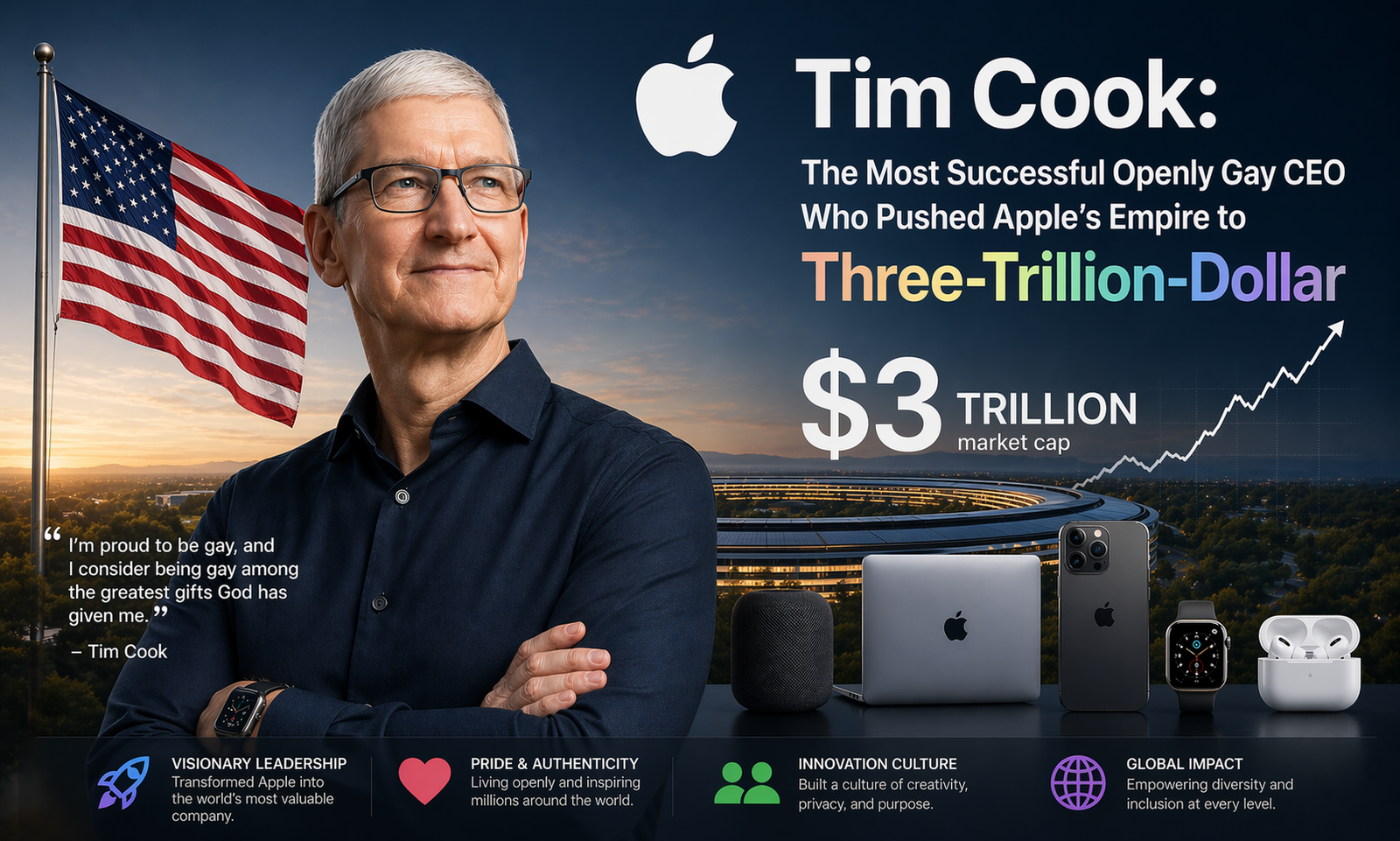
Tim Cook: The Most Successful Openly Gay CEO Who Pushed Apple’s Empire to Three-Trillion-Dollar
Timothy Donald Cook is the Chief Executive Officer of Apple Inc. He runs the most valuable company on the planet. He did not found Apple, nor did he design its most iconic early products. He took over a company defined by the unpredictable genius of Steve Jobs and transformed it into an unprecedented global financial juggernaut. Under his watch, Apple shifted from a computer and phone maker into an inescapable ecosystem of wearables, services, and custom silicon. Cook is a master of supply chain logistics, a quiet but relentless manager, and the man who proved that operational efficiency can be just as profitable as raw invention.
Alabama Roots and the Foundations of Industrial Engineering
His story starts far from Silicon Valley. Cook was born on November 1, 1960, in Mobile, Alabama, and grew up in the small town of Robertsdale. His father, Donald, worked in a shipyard. His mother, Geraldine, worked at a local pharmacy. This was a working-class environment that demanded pragmatism. Cook was a focused student. He delivered newspapers and worked at a paper mill to earn money. He attended Auburn University, graduating in 1982 with a degree in industrial engineering. Engineering taught him how to optimize systems, a skill that became his defining professional trait.
Professional Growth: From IBM to the Brink of Apple
He did not immediately jump into the startup world. Cook spent 12 years at IBM. He climbed the ranks to become the director of North American fulfillment, managing manufacturing and distribution for IBM’s personal computer company across the Americas. During this time, he also attended Duke University as a Fuqua Scholar, earning his MBA in 1988. He learned the harsh realities of hardware: unsold inventory loses value every single day.
After IBM, Cook served as Chief Operating Officer of the Reseller Division at Intelligent Electronics. In 1997, he landed the role of Vice President of Corporate Materials at Compaq. At the time, Compaq was the largest PC manufacturer in the world. Apple, conversely, was on the brink of bankruptcy.
The 1998 Interview and Choosing Intuition Over Consensus
Steve Jobs had just returned to Apple and was hunting for someone to fix the company’s disastrous manufacturing operations. Jobs met Cook in 1998. The industry consensus was that leaving Compaq for Apple was career suicide. Cook ignored the consensus. He later said he listened to his intuition. Five minutes into his interview with Jobs, he decided to join Apple.
Revolutionizing Operations and Saving Apple from Bankruptcy
He stepped into a mess. Apple had months of unsold inventory sitting in warehouses. Cook implemented a radical strategy. He closed Apple’s own factories and outsourced manufacturing to contract builders like Foxconn. He cut the number of component suppliers from 100 to 24. He forced suppliers to relocate physically closer to assembly plants. He treated inventory like dairy products, operating on the philosophy that past a few days, it spoils.
Within months, Cook reduced Apple’s inventory from an abysmal 30 days to just six days. By 1999, it was down to two days. This massive reduction in overhead saved Apple. It generated the cash flow required to fund the development of the iPod, the iPhone, and the iPad. Cook stayed out of the spotlight, but Jobs knew his value. Cook was promoted to Chief Operating Officer in 2005. When Jobs took medical leaves in 2004, 2009, and 2011, Cook ran the company.
Taking the Control: Succeeding a Visionary Founder
On August 24, 2011, Steve Jobs stepped down. He named Tim Cook as CEO. Jobs died six weeks later.
The immediate reaction from the press and Wall Street was heavy skepticism. Critics argued Apple would stagnate without its visionary founder. They misunderstood Apple’s core challenge. Jobs had already laid out the product roadmap for the next few years. What Apple needed was execution at a scale humanity had never seen. Selling five million iPhones is a design challenge. Selling two hundred million iPhones a year is a logistical war. Cook was a wartime general for logistics.
A Management Style Built on Preparation and Precision
He operates with a distinct, intimidating style. He is notoriously calm. He does not yell. Instead, he uses silence and relentless questioning. In meetings, he will ask a manager a detailed question about a spreadsheet. If the manager answers correctly, Cook asks another, slightly deeper question. He continues this until the manager either breaks down or admits they do not know the answer. This forces his executives to know their operations flawlessly. He wakes up before 4:00 AM every day, reads user emails, hits the gym, and arrives at the office ready to dissect the global supply chain.
Expanding the Ecosystem: The Rise of Wearables
Under Cook, Apple did not just survive; it expanded into entirely new categories. The Apple Watch launched in 2015. Tech reviewers initially dismissed it as a confusing gadget. Cook ignored the noise and pivoted the device’s focus toward health and fitness. Today, the Apple Watch single-handedly outsells the entire Swiss watch industry.
He then introduced AirPods in 2016. Removing the headphone jack from the iPhone caused public outrage. Cook forced the transition to wireless audio. AirPods quickly became a cultural phenomenon and a multi-billion dollar business on their own.
The Strategic Shift to Services and Apple Silicon
Cook’s most lucrative strategic move was the aggressive expansion of Apple Services. He realized the iPhone market would eventually saturate. To keep revenue growing, Apple had to monetize the massive base of active devices. He pushed Apple Music, iCloud subscriptions, Apple Pay, Apple TV+, and Apple Arcade. Services now generate tens of billions of dollars every quarter, providing Apple with a reliable, recurring revenue stream that insulates it from hardware sales cycles.
He also oversaw the most significant internal engineering shift in Apple’s history: the transition to Apple Silicon. Frustrated with Intel’s stagnant chip development, Apple designed its own M-series processors for Mac computers. The result was a line of laptops and desktops that offered unheard-of speed and battery life, completely resetting the standard for the entire computer industry.
First Openly Gay CEO of Fortune 500 Company
Cook uses his position to enforce a distinct set of corporate values. He firmly established privacy as a fundamental human right. He positioned Apple against data-mining giants like Meta and Google, building strict app-tracking transparency tools into the iPhone operating system. This move crippled Facebook’s ad revenue and cemented Apple’s reputation as a protector of user data.
He also committed Apple to extreme environmental goals. He pushed the company to power all its corporate facilities with 100% renewable energy and set a hard deadline of 2030 for Apple’s entire supply chain and product lifecycle to be completely carbon neutral.
In 2014, Cook wrote an essay for Bloomberg Businessweek stating, “I’m proud to be gay, and I consider being gay among the greatest gifts God has given me.” This made him the first openly gay CEO of a Fortune 500 company. He chose to come out publicly to support youth who felt isolated by their sexuality. He frequently speaks out on human rights, equality, and immigration reform.
Leading into the Future: Spatial Computing and Apple Intelligence
Cook’s current strategy focuses on two massive technological shifts. The first is spatial computing. In early 2024, Apple launched the Vision Pro headset. It is a high-priced, first-generation product that signals Cook’s belief that mixed reality is the next major computing platform after the smartphone.
The second is artificial intelligence. As competitors rushed to launch generative AI chatbots, Cook remained characteristically patient. In late 2024, he rolled out “Apple Intelligence.” True to his form, the implementation prioritizes on-device processing and user privacy over flashy, error-prone cloud models. He is integrating AI seamlessly into the existing Apple ecosystem rather than treating it as a separate novelty.
Diversifying the Global Supply Chain and Professional Legacy
Simultaneously, Cook is executing a massive geographical pivot. Recognizing the geopolitical risks of keeping Apple’s entire manufacturing base in China, he is aggressively moving production lines to India and Vietnam. He travels constantly to negotiate with foreign leaders, securing tax breaks and labor agreements to build a more resilient, diversified supply chain.
Cook rarely relies on flashy rhetoric. His motivational approach is grounded in preparation and duty. “You don’t have to choose between doing good and doing well,” he often tells graduating classes. He emphasizes that the most critical decisions are made long before a crisis occurs, built entirely on the foundation of rigorous daily work.
He inherited a highly successful company. He turned it into an institution. Tim Cook proved that while vision creates a product, flawless execution builds an empire.