
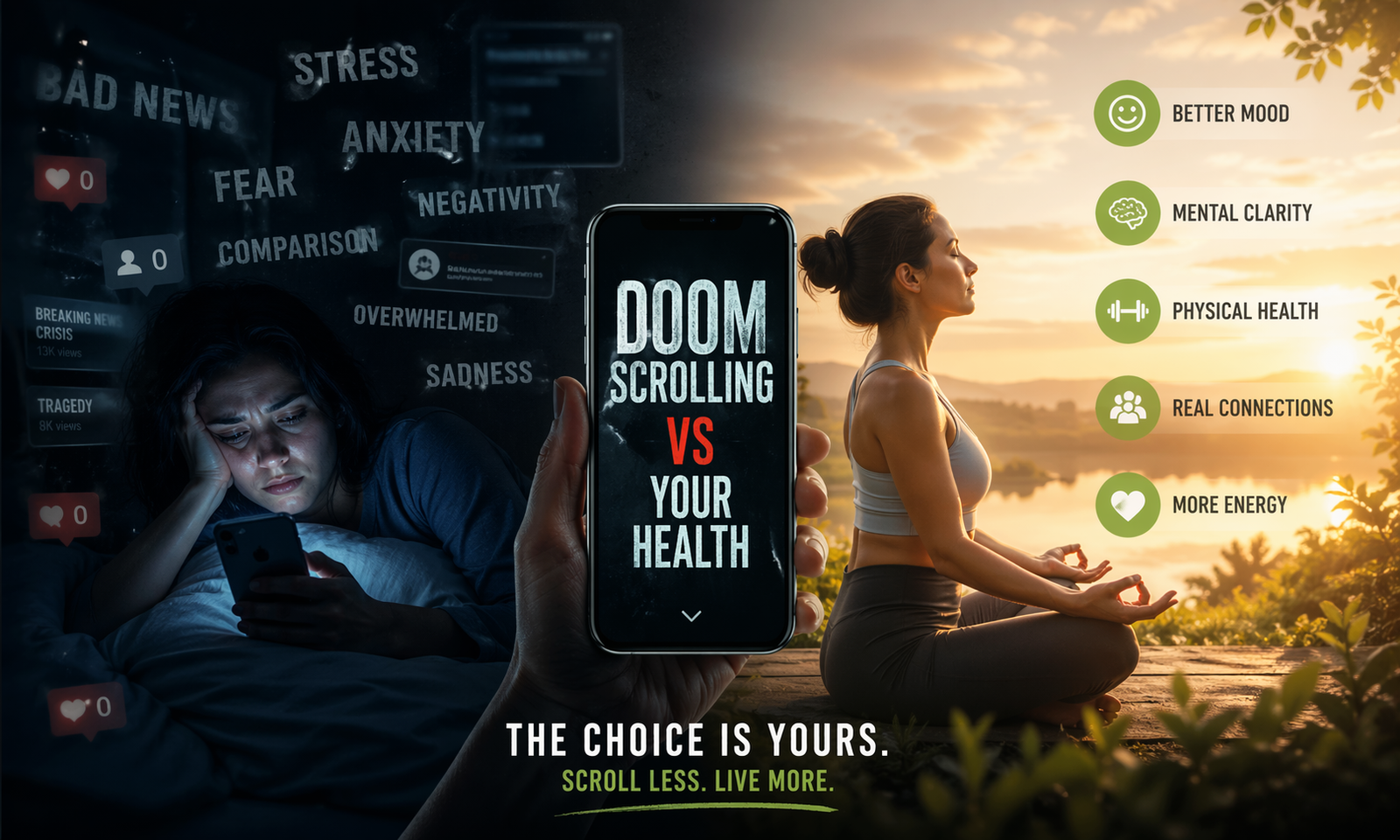
The Science of the Scroll: How Doomscrolling and Short Videos Hack the Human Brain
Doomscrolling is the act of spending excessive time reading negative news online. Short-form video consumption involves watching continuous, algorithmically curated clips typically lasting under 60 seconds. Both behaviors emerged as dominant internet habits over the last decade. Health professionals track these activities closely because they alter brain chemistry, disrupt sleep, and change how people process information.
The Invention of the Endless Feed
The foundation for modern screen addiction was laid in 2006. Aza Raskin, a user interface designer, created the infinite scroll. His goal was simple: make web browsing seamless. Previously, users had to click a “next page” button at the bottom of a screen. That button served as a natural stopping cue. It gave the brain a fraction of a second to decide whether to continue or step away.
Removing that friction changed human behavior permanently. The feed never ends. There is no bottom to reach. Without a physical cue to pause, the default human action is to keep moving the thumb. Raskin later expressed deep regret for the invention, comparing its effect on the brain to behavioral cocaine.
Tech companies weaponized this seamless experience. In 2009, Facebook introduced the “Like” button. Twitter added the “Retweet.” These features gamified social interaction. The platforms realized that keeping users on the site required a constant stream of novel information. The infinite scroll provided the delivery method. Human psychology provided the vulnerability.
The Rise of Doomscrolling
The term doomscrolling entered the public vocabulary around 2018 on Twitter, but it exploded into a global phenomenon during the 2020 pandemic. People were locked inside, frightened, and uncertain about the future. They turned to their screens for answers.
This behavior is rooted in a psychological concept called the negativity bias. Early humans survived by paying strict attention to threats. A rustling bush might be a predator. Ignoring the positive was safe; ignoring the negative was deadly. The modern human brain still operates on this survival hardware. When you encounter a frightening headline, your brain registers it as a physical threat.
You read the bad news. Your body activates the fight-or-flight response. The adrenal glands release cortisol, the primary stress hormone. Your heart rate elevates slightly. Your breathing becomes shallower. You feel anxious. To resolve this anxiety, you look for more information. You scroll further down the feed, hoping to find a solution or a sense of safety. Instead, the algorithm feeds you more disaster. The internet has no resolution.
This creates a high-cortisol loop. You are physically safe on your couch, but your nervous system believes it is under attack. Hours pass. The extended exposure to cortisol degrades your mental health. It leads to chronic anxiety, depressive episodes, and a persistent feeling of dread about the state of the world.
The Short Video Revolution
While doomscrolling hijacked the brain’s threat-monitoring system, a new format arrived to hijack the reward center.
Vine proved the concept of six-second looping videos in 2013, but the platform eventually collapsed. TikTok perfected the model and launched globally in 2018. It stripped away the traditional social media mechanics. You did not need to follow friends or build a network. You simply opened the app, and a full-screen video started playing.
Instagram immediately copied this design with Reels. YouTube aggressively pushed Shorts. The tech industry realized that text requires effort. Reading demands active cognitive participation. Short-form video is entirely passive.
The algorithm controlling these videos is ruthless. It tracks every micro-action. It measures how many milliseconds you hover on a video before swiping. It notes if you rewatch a clip. It maps your exact preferences within ten minutes of use. You do not choose what to watch. The application watches you, and it serves exactly the content required to paralyze your attention.
The Slot Machine in Your Pocket
Short videos operate on the exact same psychological principle as a casino slot machine. This is known as a variable ratio schedule of reinforcement, a concept proven by psychologist B.F. Skinner in the 1950s.
When you swipe up to see the next video, you pull a digital lever. You do not know if the next 15-second clip will be hilarious, boring, or enraging. That unpredictability is the core of the addiction. If every video were perfectly entertaining, you would eventually get bored and leave. The occasional boring video makes the next funny video feel like a massive win.
When you see something you like, your brain releases dopamine. Dopamine is not just a pleasure chemical; it is the neurotransmitter responsible for motivation and craving. It teaches the brain that a specific action yields a reward, and it compels you to repeat that action.
You get a dopamine hit from a dog video. The video ends. The dopamine level drops. You experience a micro-craving. You swipe. You get another hit. This rapid cycling exhausts the brain’s dopamine receptors. Over time, normal activities like reading a book or having a conversation do not produce enough dopamine to hold your interest. The world outside the screen feels gray and agonizingly slow.
The Destruction of Focus
Attention spans are not shrinking organically. They are being forcefully retrained.
Neuroplasticity is the brain’s ability to rewire itself based on experience. When you feed your brain a new piece of highly stimulating information every 15 seconds for hours a day, the brain adapts to that pace. It begins to expect constant, rapid shifts in context.
Teachers see the fallout in modern classrooms. Students struggle to read a single page of text without feeling a compulsive urge to check a device. The ability to engage in deep work is vanishing. Deep work requires pushing through initial boredom to reach a state of flow. Short-form videos teach the brain to escape boredom instantly by moving a finger. The muscle required for sustained concentration atrophies from lack of use.
The Physical Toll
The damage extends far beyond mental focus. Staring at a rapidly moving feed physically alters your body.
Human beings typically blink around 15 to 20 times a minute. When staring at a screen, especially during intense focus or algorithm-driven scrolling, that rate drops by half. This leads to chronic dry eye, blurred vision, and permanent changes in tear duct function.
Posture suffers immensely. Looking down at a smartphone tilts the heavy human head forward. This unnatural angle puts up to 60 pounds of pressure on the cervical spine. Orthopedic surgeons refer to this condition as tech neck. It causes severe muscle tension, chronic headaches, and premature wear on the spinal discs.
Sleep is the most immediate casualty. The blue light emitted by phone screens tricks the pineal gland into halting the production of melatonin, the hormone that regulates sleep cycles. But the light is only half the problem. The content itself acts as a stimulant. You cannot transition directly from a high-speed dopamine rush, or a cortisol-spiking news feed, into restful sleep. The brain remains in a state of hyper-arousal.
Chronic sleep deprivation cascades into severe medical issues. It drives weight gain, elevates blood pressure, wrecks the immune system, and guarantees cognitive fog the following day. The user wakes up tired, seeks out a screen for stimulation, and the cycle repeats.
The Current Landscape
The public perception of these platforms shifted drastically in recent years. Users are acutely aware they are trapped. Screen time reports on modern devices show terrifying weekly averages, forcing people to confront their lost hours.
Internal documents leaked from major tech companies confirm that executives know their products cause harm. They know the algorithms promote eating disorders, depression, and severe anxiety, particularly in teenagers. They prioritize engagement metrics over human well-being because their business models rely on selling advertisements. You cannot sell ads to someone who puts their phone down.
Lawmakers are now targeting the core mechanics of the feed. Debates focus heavily on algorithmic transparency and age verification. Several school districts face pressure to ban smartphones entirely during the school day, forcing students back into physical reality.
The tech companies are attempting a defense. They push creators to make longer content, claiming a desire for high-quality engagement. They offer in-app reminders to take a break. These are public relations tactics designed to avoid government regulation. A popup reminder to go to sleep does not counteract a billion-dollar algorithm engineered to keep you awake. The fundamental product remains the endless feed.
Taking Back Control
Willpower fails against an algorithm built by thousands of the smartest engineers in the world. You cannot out-think the feed. You have to change your physical environment.
Turn your phone screen to grayscale. You can find this setting in the accessibility menu. Without bright, saturated colors, the videos lose their immediate visual hook. The brain stops recognizing the screen as a high-value reward center.
Delete the apps from your phone. If you want to watch videos or read the news, force yourself to log in on a desktop computer. Adding physical friction breaks the automatic habit of tapping an icon.
Buy a physical alarm clock. Keep the smartphone entirely out of the bedroom. If the phone is on the nightstand, you will inevitably reach for it when you cannot sleep.
The devices in our pockets are built to harvest human attention. The algorithms do not care about your health, your sleep, or your sanity. They only care about time on screen. Recognizing that the screen is a hostile environment is the first necessary step to escaping it.