The SpaceX and Tesla Merger Is No Longer a Rumor
The largest initial public offering in financial history just took place on June 12. SpaceX hit the public markets with a staggering valuation of $1.77 trillion. Investors bought up $75 billion in shares instantly. The sheer scale of the financial event eclipsed the previous records set by Saudi Aramco and completely rewrote the rules of Wall Street. Yet the most significant news of the day had nothing to do with rockets. It had everything to do with cars.
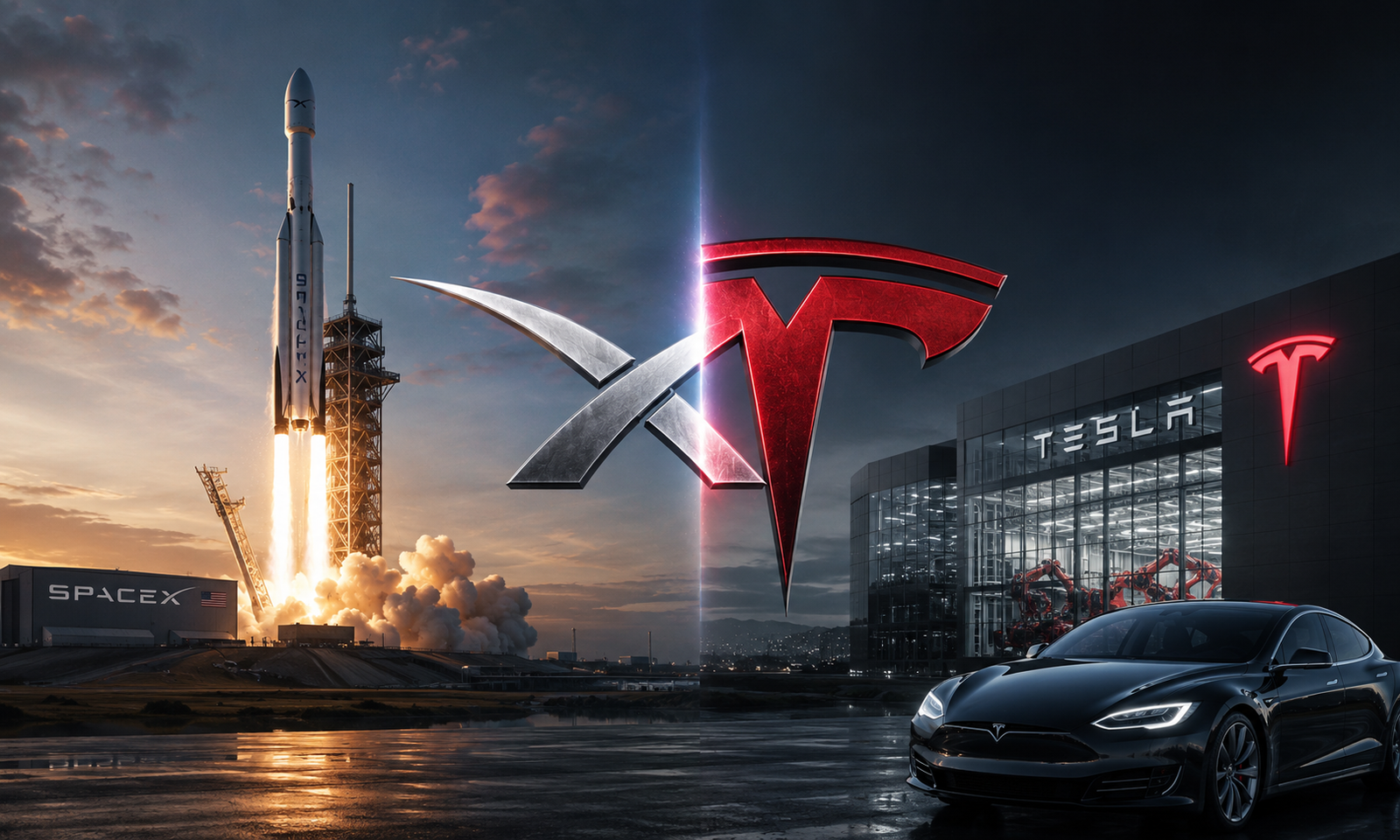
SpaceX President Gwynne Shotwell went on television and casually shattered the firewall between Elon Musk’s two largest empires. When asked about a potential merger with Tesla, she did not dismiss the idea. She stated that combining the companies might make life a little easier for Musk. She explicitly acknowledged the undeniable synergies between the two corporations. Shotwell followed up with standard corporate deflection by stating her current focus remains on keeping the lights on and launching rockets. The financial world heard the real message loud and clear. A total consolidation of the Musk empire is actively on the table.
The New Currency of Conquest
Before June 12, a merger between the aerospace giant and the electric vehicle manufacturer was purely theoretical. SpaceX was a private entity. Buying a massive public company like Tesla would have required impossible amounts of debt or complex leveraged buyouts. The initial public offering changed the fundamental math overnight. SpaceX now possesses liquid public stock. That stock functions as the ultimate corporate currency. The company can now purchase other businesses simply by issuing its own highly valued shares to fund the transactions.
We already saw this strategy begin to unfold earlier in 2026. SpaceX quietly absorbed Musk’s artificial intelligence startup xAI in February for $250 billion. That massive acquisition proved the aerospace company is no longer just building orbital transport vehicles. It is building an overarching technology conglomerate. Tesla remains the final massive piece sitting entirely outside the main tent.
Musk currently runs two separate public megacorporations simultaneously. This divided corporate structure creates massive daily friction. It forces him to split his time, resources, and top engineering talent between two entirely different shareholder bases. Bringing Tesla under the SpaceX umbrella solves this geographic and mental divide immediately. It unifies his workforce under a single banner and eliminates the constant scrutiny over where he spends his working hours.
The Anatomy of a Single Organism
Look closely at how the two companies operate today. They already function remarkably like a single biological organism. The supply chains overlap aggressively. SpaceX spent $143 million purchasing Tesla vehicles and Cybertrucks for its Starbase launch facilities and corporate campuses last year. Tesla engineers frequently share advanced manufacturing techniques and materials science breakthroughs with the rocket development team.
The physical technology is merging rapidly as well. Starlink satellite hardware is being integrated directly into the upcoming Tesla Cybercab autonomous vehicles to ensure absolute connectivity anywhere on the planet. The two companies are also jointly constructing a massive semiconductor fabrication project called Terafab in partnership with Intel. They are pooling their immense capital resources to build the physical computer chips required to train massive artificial intelligence networks.
These are not the actions of two fiercely independent companies. These are the actions of a unified corporate state waiting for the legal paperwork to catch up with reality. Former Tesla director Steve Westly summarized the situation perfectly on the morning of the initial public offering. He told financial networks that a merger is absolutely likely. He pointed out the obvious reality that Musk wants everything housed under one central roof.
The Data Ecosystem and the 80 Percent Bet
Wall Street analysts are no longer treating the merger as a distant science fiction possibility. Dan Ives runs technology research at Wedbush Securities and tracks the Musk ecosystem closely. Ives went on the record stating there is an 80 percent probability that Tesla and SpaceX will formally merge within the next twelve months. Ives completely dismissed the idea that this is just about making Musk’s daily schedule easier. He identified the true motivation driving the megadeal. It is entirely about artificial intelligence and raw data control.
Artificial intelligence requires an incomprehensible amount of training data to function correctly. Tesla possesses the largest real world visual data set on the planet through its millions of cars driving on public roads every single day. SpaceX controls the global broadband infrastructure through thousands of Starlink satellites orbiting the earth. SpaceX also owns the xAI infrastructure and the massive Colossus data center where the training actually happens.
Separating the data collection from the data processing creates unnecessary legal and financial barriers. Merging the companies eliminates those barriers completely. It allows Musk to feed Tesla autonomous driving data directly into the SpaceX artificial intelligence supercomputers without worrying about shareholder lawsuits or corporate licensing agreements. Ives correctly points out that investors buying SpaceX stock today are not just buying a space exploration company. They are buying a golden ticket into a closed ecosystem controlled entirely by one man.
The Governance Trap and Valuation Risks
A merger of this magnitude faces terrifying legal and structural hurdles. Governance remains the absolute largest obstacle in the room. Musk currently holds more than 80 percent of the voting power at SpaceX. He dictates every major decision and retains the absolute right to veto his own removal from the board. If SpaceX absorbs Tesla, Musk instantly gains supreme dictatorial control over a second trillion dollar entity.
Tesla shareholders might fight this aggressive consolidation. Many mutual funds and retail investors bought Tesla specifically because they wanted pure financial exposure to the global electric vehicle market. They might not want their investment diluted by massive capital expenditures on Mars rockets or orbital space stations. The valuation math is equally precarious. SpaceX lost nearly $5 billion last year despite its massive public valuation. Merging a highly profitable car manufacturer with a cash burning aerospace project changes the fundamental risk profile for everyone involved.
Tesla investors already suffered a major scare when the confidential IPO filing leaked in April. Tesla stock dropped sharply over the following ten days because investors feared a massive capital diversion. They worried that institutional funds would pull their money out of the car company to buy into the exciting new rocket company. On the other hand, when Tesla confirmed massive vehicle sales to SpaceX in May, the stock rallied violently. The market clearly rewards the companies when they act together as an economic unit and punishes them when they compete for the same investment dollars.
The Global and Political Stakes
The consolidation of SpaceX and Tesla creates a corporate entity with unprecedented geopolitical leverage. SpaceX currently conducts more orbital launches annually than the entire Chinese space program. It holds vital contracts with NASA and the United States Armed Forces. The Starshield defense network makes the company an indispensable branch of national security. Tesla meanwhile manages massive manufacturing operations across three continents and dictates the pace of global energy storage.
Fusing these two entities transforms them from successful technology companies into a sovereign corporate power. No single company in human history has simultaneously controlled global automotive transport, the dominant satellite communications network, massive artificial intelligence server farms, and exclusive access to low earth orbit. Competitors like Jeff Bezos and his Blue Origin space program will find themselves fighting a monolithic giant capable of subsidizing its rocket launches with electric vehicle profits.
The federal government will inevitably scrutinize this deal. Antitrust regulators typically look for monopolies within specific industries. A SpaceX and Tesla merger challenges traditional regulatory frameworks because it creates a vertical monopoly across multiple unrelated sectors. Regulators will have to decide if one person should possess absolute voting control over both the roads on Earth and the satellites in the sky.
Retail Mania and the Trillion Dollar Question
You absolutely cannot ignore the retail investor element in this unfolding corporate drama. The SpaceX public debut allocated 30 percent of its entire available float directly to retail traders. That is roughly three times the normal allocation for a company of this size. Retail investors submitted orders totaling over $100 billion. The sheer demand crashed brokerage applications and forced market makers to scramble wildly for available shares. BlackRock alone placed a $5 billion order.
These retail investors are largely the exact same people who drove Tesla to its astronomical market heights over the past decade. They believe in the vision completely. They do not care about traditional price to earnings ratios or quarterly cash flow statements. They are buying the idea of a unified technological future. A formal merger plays perfectly to this exact audience. It creates the ultimate mega stock. It packages self driving cars, humanoid robots, artificial intelligence, and interplanetary travel into a single corporate ticker symbol.
Gwynne Shotwell understands this dynamic perfectly. She is a notoriously disciplined operations executive who never speaks off the cuff to the media. Her decision to float the merger concept on national television during the most important financial day in her company history was highly calculated. She planted the seed in the minds of the public. She gave the financial press exactly what they needed to start socializing the idea.
The rockets will continue flying. The electric cars will continue rolling off the assembly lines. But the corporate walls separating them are dissolving rapidly. The largest public offering in history just handed Elon Musk the exact financial tool he needs to finish the job. We are no longer waiting to see if SpaceX and Tesla will merge. We are just waiting for the lawyers to finalize the paperwork.