

Most Influential Logistics Industry Innovator – 2026
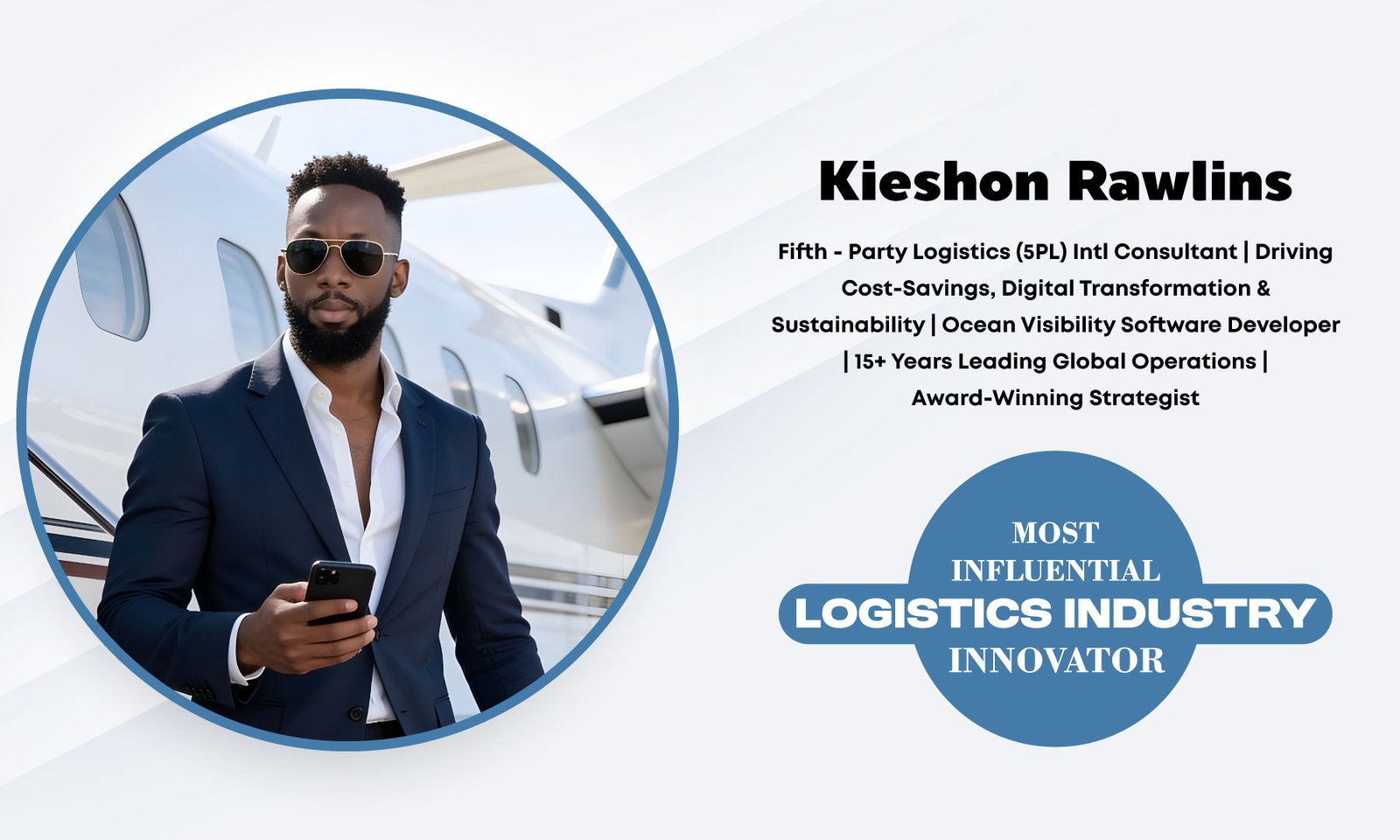
Kieshon Rawlins: Redesigning Global Supply Chains Through Glocalization and Tech
Kieshon Rawlins is a logistics professional and supply chain system designer. He began his career in Barbados, observing how the movement of goods by sea directly affected local communities and businesses. Today, he operates a global logistics service that integrates strategy, technology, and execution for international trade. He focuses heavily on emerging markets, including the Caribbean, Latin America, and Africa. For his work in restructuring global supply ecosystems and developing new logistics platforms, Kieshon Rawlins has been recognized as one of the Most Influential Logistics Industry Innovators of 2026. This article explores his career history, his operational methods, and the specific technology platforms he is developing to improve global supply chains.

The Foundations of a Systems Architect
His journey into the complex world of global trade did not begin in a corporate boardroom, but rather on the docks of Barbados. Growing up on an island nation, he witnessed firsthand how international shipping lines served as the lifeblood of the community. He observed the invisible choreography of logistics—how time, physical distance, and human decision-making converge to create access to essential goods. He saw that a single delayed shipping container could ripple through an entire local economy.
This early exposure led him to pursue logistics not simply as the management of trucks and warehouses, but as the rigorous discipline of systems design. His early roles in regional freight provided him with the fundamental mechanics of the industry, while subsequent international exposure taught him the high stakes involved in global movement. The tension between the realities of operating on an island and the staggering complexity of global trade became the proving ground for his career. He learned to solve for flow in environments where the margin for error was virtually zero.
A defining moment in his early career came through the guidance of a Barbadian operations manager named Mr. Holder. Holder imparted a hard truth that would become a cornerstone of his professional philosophy: “In logistics, nobody calls to say thank you. They call when it’s broken. Your job is to be the reason the phone stays quiet.”
This lesson was put to the test during a severe hurricane disruption. At 3:00 a.m., Kieshon and Mr. Holder walked the docks, re-routing critical medical cargo entirely by hand. There were no digital systems online to assist them; the operation relied purely on established human relationships and sharp professional judgment. That night solidified two doctrines that He continues to utilize today. First, relationships are actual infrastructure. Second, contingency planning is not merely a slide in a corporate presentation—it must be muscle memory. Through Mr. Holder, Kieshon learned that true leadership in logistics.
Decoding Global Complexity and Glocalization
For him, global trade is applied economics happening in real-time. It is an arena where tariffs, geopolitical shifts, foreign exchange rates, cultural differences, weather patterns, and human behavior collide within a single purchase order. This intellectual demand, coupled with the moral weight of the work, is what initially drew him to the field. When supply chains function correctly, grocery shelves are stocked, manufacturing plants continue to run, and the livelihoods of millions of people are protected. Kieshon set out to master the systems that keep modern life functioning, with a specific goal of redesigning them to be more equitable for smaller, often-overlooked markets like the Caribbean.
Working across multiple countries and diverse markets taught Kieshon a vital personal lesson: humility. He quickly realized that no two borders operate or think in the exact same way. As he notes, assuming that a standard process from Miami will seamlessly apply in Manila is a form of professional arrogance.
Professionally, his global exposure reinforced that local context will always beat a rigid template. He learned to design supply chain solutions that account for variance rather than relying on industry averages. He developed the ability to read the silence in international negotiations, to respect the intricacies of informal trade corridors, and to build operational solutions capable of surviving sudden political shocks.
He refers to this core lesson as “glocalization”—the execution of global standards filtered through deep local intelligence. In the logistics industry, markets do not adapt to the service provider; rather, the provider must earn the right to operate by deeply understanding the market.
The 5PL Revolution: Eliminating the Complexity Tax
As he advanced in his career, he identified a glaring blind spot in the broader logistics industry: major providers overwhelmingly optimized their services for large-volume shipping lanes, treating emerging markets as afterthoughts. He repeatedly witnessed small and medium-sized enterprises (SMEs) in the Caribbean, Africa, and Latin America paying what he terms a “complexity tax.” Because these smaller businesses did not fit the traditional Fourth-Party Logistics (4PL) mold, they were subjected to higher operational costs, longer lead times, and significantly less visibility into their own supply chains.
Motivated to correct this imbalance, Kieshon built his own approach to logistics and supply chain services. He developed a Fifth-Party Logistics (5PL) model designed to integrate strategic planning, technological infrastructure, and physical execution under a single accountability structure. His motivation was clear: if he could collapse the friction for the smallest players in the market, he could unlock disproportionate economic growth for those regions. He operates on the belief that innovation and efficiency should not be exclusive privileges reserved only for massive corporate scale.
Today, operating at the 5PL layer, Kieshon does not merely move freight; he architects entire supply ecosystems. His work encompasses network design, the implementation of digital control towers, advanced risk modeling, and strict trade compliance—all wrapped into one Profit and Loss (P&L) responsibility. He focuses his expertise on three specific client types: high-growth exporters seeking new markets, post-disruption recovery projects requiring total rebuilds, and public-private initiatives aimed at bolstering island resilience.
For him, the most exciting aspect of his work is turning raw data into operational doctrine. When his team transitions a client from 28 days of operational uncertainty to 7 days of absolute certainty with live exception management, they are doing more than saving money. They are buying the client time—time to innovate, to serve their communities, and to focus on growth.
The 5PL Framework featured in this article is detailed further in his upcoming book , Glocal: The New Rules of Supply Chain in a World That’s Both Connected and Divided

A Day in the Life of a Global Orchestrator
Managing complex international operations requires a rigorous and highly structured daily routine. His day operates on three distinct geographic clocks: Asia, Europe, and the Americas.
His morning begins at 4:30 a.m. with a comprehensive review of exception dashboards, immediately identifying any supply chain failures that occurred overnight. By 6:00 a.m., he is focused on stakeholder alignment. This involves coordinating with customs brokers, ocean carriers, and client operations teams across various communication channels, from WhatsApp and Microsoft Teams to traditional phone calls.
The midday block is dedicated to high-level strategic work. During this time, Kieshon is modeling lane risk, renegotiating carrier terms, or war-gaming potential scenarios such as sudden fuel price spikes or impending port strikes.
Afternoons are reserved for deep, focused work, primarily designing Standard Operating Procedures (SOPs) that are robust enough to survive inevitable staff turnover and technology failures. The evenings are utilized for daily debriefs and horizon scanning to anticipate future market shifts. While no two days are ever exactly the same, every day concludes with he asking himself one critical question: “Where is tomorrow’s failure hiding, and did we already fix it today?”
Crisis Engineering and the Power of Trust
One of the most significant challenges of his career occurred in the turbulent post-pandemic landscape. He was tasked with leading a multi-country operational relaunch for a manufacturing client whose entire Asia-to-Latin America-to-Caribbean shipping lane had completely collapsed. The situation was dire: freight rates had skyrocketed by 400 percent, schedule reliability had plummeted to under 35 percent, and the client’s cash flow was rapidly choking.
Kieshon recognized that the core challenge in this crisis was not just cost—it was trust. To solve the problem, he and his team rebuilt the client’s supply chain from absolute zero. They meticulously mapped out tier-2 suppliers, diversified shipping volume by splitting it across nearshore and regional hubs, and introduced a digital twin model for highly accurate inventory tracking. Furthermore, He negotiated dynamic Service Level Agreements (SLAs) with carriers that were tied to actual service credits, moving away from standard, often unenforceable, penalty clauses.
He overcame the crisis by replacing operational hope with hard mathematical models and transforming standard contracts into true partnerships. Within nine months, the client’s On-Time In-Full (OTIF) delivery rate surged from a failing 41 percent to an exceptional 93 percent. Simultaneously, the client’s working capital requirements dropped by 22 percent. For him, the true victory was not merely the improved metrics, but proving definitively that supply chain resilience can be engineered, even in the harshest conditions.
Compliance as C-Suite Strategy
In his extensive experience helping businesses navigate cross-border trade, he consistently observes one major mistake: companies treating trade compliance as a simple administrative duty and supply chain visibility as solely an IT problem.
Many executives mistakenly view customs clearance, Harmonized System (HS) classification codes, and Incoterms as back-office tasks meant for clerks. He argues that in reality, compliance is a core business strategy. A single incorrect HS code or misunderstood Incoterm can instantly erase a company’s profit margin and trigger severe government audits that can freeze corporate growth for multiple quarters.
His solution to this widespread problem is clear: companies must elevate trade compliance discussions directly to the C-suite. Furthermore, businesses must invest in real-time supply chain visibility before they invest in mere shipping speed. As Kieshon frequently advises his clients, if you cannot see the freight, you cannot fix the problem. If customs authorities cannot clear the goods, the velocity at which the ship crossed the ocean is entirely irrelevant.
Real-World Impact: Unlocking Global Markets
His systems design frequently yields real-world impacts. One notable example involves a Barbadian agro-processor aiming to enter the highly regulated European Union market. The processor was struggling to meet the EU’s stringent cold-chain documentation requirements and strict lead-time demands.
Kieshon completely redesigned their export model. He consolidated Less-than-Container Load (LCL) shipments into a shared refrigerated container (reefer) equipped with live IoT monitoring. He ensured all cargo was pre-cleared with EU authorities using digitized Hazard Analysis Critical Control Point (HACCP) data. Strategically, he shifted their shipping terms from Ex Works (EXW) to Delivered at Place (DAP), providing complete transparency regarding landed costs.
The results were transformative. The first shipment arrived on retail shelves in Rotterdam in exactly 18 days, a massive improvement over the client’s previous 42-day failure rate. Within six months, the agro-processor had secured placement in three major European retail chains, hired 14 new employees, and tripled their purchasing contracts with local farmers. For him, the true measure of impact is never just the safe arrival of a shipping container; it is the local jobs created and the agricultural acres unlocked back home.
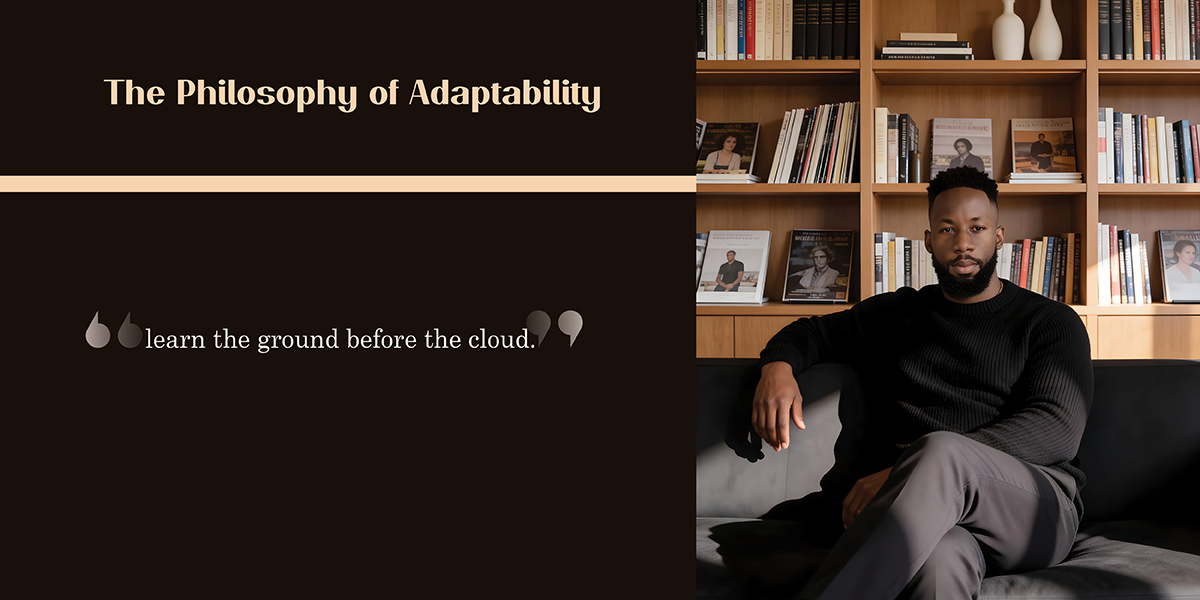
The Philosophy of Adaptability
To maintain focus and adaptability in an industry characterized by rapid, relentless change, Kieshon operates by a strict personal doctrine: “Standardize the variable, and variabilize the standard.”
Under this philosophy, his teams rigidly lock down elements that must never be compromised, such as physical safety, regulatory compliance, and data integrity. Conversely, they deliberately build flexibility into elements that must adapt to changing conditions, such as shipping routes, transportation modes, and vendor partnerships.
He ensures his own adaptability through dedicated time-blocking. He commits five hours every week exclusively to studying regulatory shifts, emerging logistics technologies, and global geopolitics. He believes that true adaptability is not about raw reaction speed, but about having pre-built options ready to deploy. He maintains a live playbook of detailed ‘if-this-then-that’ scenarios for global disruptions. Focus, he notes, comes from the discipline of saying no; if a new trend or tool does not actively reduce risk, time, or cost for a client, he dismisses it as mere noise.
When advising young professionals seeking a career in logistics and international trade, Kieshon stresses the importance of foundational knowledge. He advises them to “learn the ground before the cloud.” He urges young workers to spend actual time on loading docks, inside active warehouses, and at physical border posts to understand how a piece of paper actually translates to physical movement.
Beyond operational basics, he advises mastering three distinct languages: data analytics, corporate finance, and international diplomacy. In his view, logistics is 30 percent operations and 70 percent human influence. The most valuable professional is the one who can seamlessly explain demurrage fees to a CFO in the morning and coordinate with a dockworker in the afternoon. While industry certifications hold value, true credibility is earned by stepping up to solve a 2:00 a.m. crisis that no one else is willing to touch. Ultimately, careers in global trade are built on consistent reliability, not sporadic heroics; professionals must think in sustainable systems, not individual shipments.
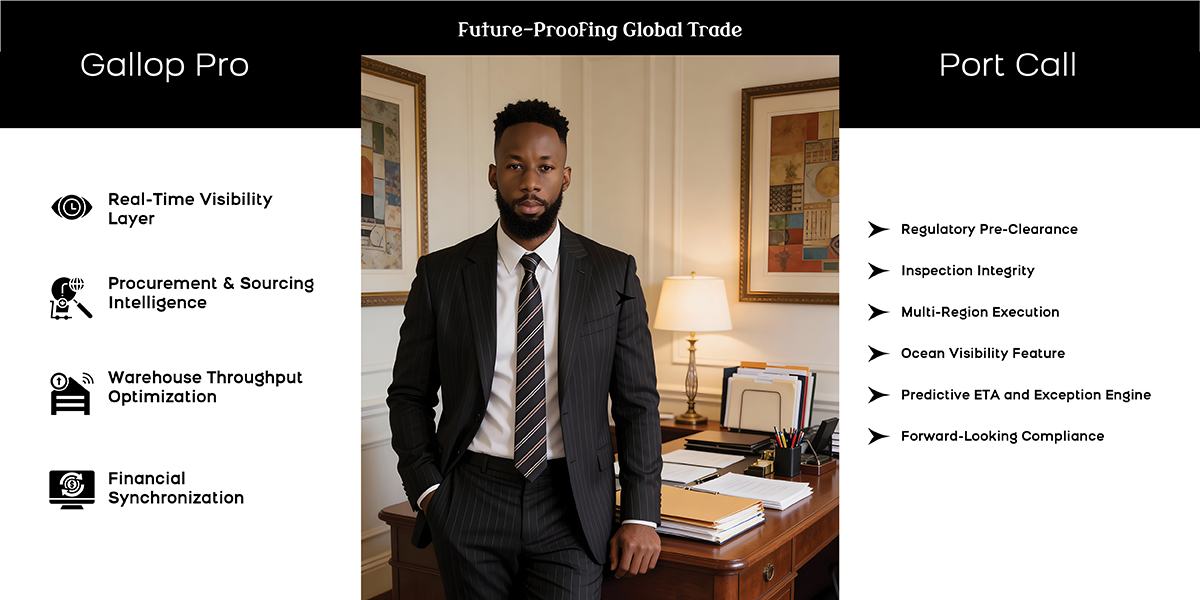
Future-Proofing Global Trade: Gallop Pro and Port Call
Looking toward the future, He is not just advising on supply chains; he is actively coding their future. He is currently developing two sophisticated web applications designed to solve the exact pain points he has spent his career fighting.
Gallop Pro
Gallop Pro is an enterprise logistics orchestration platform built to accelerate decision velocity across procurement, warehousing, and distribution nodes. The system is designed to streamline operations across several critical layers:
- Real-Time Visibility Layer: The platform integrates AI-enhanced reporting and live tracking to monitor shipment progress globally. It is designed to proactively flag operational bottlenecks before Service Level Agreements (SLAs) are breached, effectively replacing fragmented email chains and static Excel updates with a single source of operational truth.
- Procurement & Sourcing Intelligence: Gallop Pro centralizes supplier data and critical compliance documents, supporting corporate strategies that must balance operational cost, product quality, and environmental sustainability.
- Warehouse Throughput Optimization: The platform targets the reduction of order processing time and excess inventory overhead by fully digitizing storage, handling, and pick-and-pack workflows.
- Financial Synchronization: The system structures vendor payment terms and trade finance mechanisms to significantly improve cash-flow efficiency for both buyers and sellers.
The ultimate result for enterprise companies using Gallop Pro is faster supply chain cycle times, lower overall freight spend, and a drastic reduction in customs delays through automated pre-shipment certification and documentation.
Port Call: Ocean Visibility
His second platform, Port Call: Ocean Visibility, is a highly specialized compliance, documentation, and tracking system focused entirely on the notoriously difficult “first mile and last mile” of international trade. It is specifically engineered to handle pre- and post-shipment certification, physical inspections, port interface protocols, and live vessel tracking.
- Regulatory Pre-Clearance: Port Call manages complex verification processes to ensure goods meet all destination-country and end-customer documentation requirements long before the vessel ever sets sail. This feature directly addresses the “nightmare customs delay” problem that routinely plagues international shippers.
- Inspection Integrity: The system coordinates rigorous Quality Assurance (QA) processes to maintain the physical integrity of products from their origin to their final destination, thereby reducing expensive rejections and product rework.
- Multi-Region Execution: Because his 5PL model requires coordinating with ocean carriers, customs brokers, and warehouse operators across more than 11 countries, Port Call is built to strictly standardize the flow of data and physical handoffs at diverse global port nodes.
- Ocean Visibility Feature: The platform boasts real-time container and Bill of Lading (BL) tracking across more than 150 global ocean carriers and 2,000 international ports. Users can track freight via B/L Number, Container Number, or Booking Number. The system automatically ingests Electronic Data Interchange (EDI), Automatic Identification System (AIS) vessel data, and critical carrier milestones including Gate In, Loaded, Departed, Transshipped, Discharged, Gate Out, and Empty Return.
- Predictive ETA and Exception Engine: Utilizing Machine Learning (ML) models, the platform automatically recalculates Estimated Times of Arrival (ETA) based on live delays, severe weather events, or port congestion. It automatically flags high-risk events such as “Rolled” cargo, “Customs Holds,” or “Demurrage Risk” up to seven days before the financial penalty is incurred.
- Forward-Looking Compliance: The underlying architecture of Port Call supports blockchain-based traceability and predictive risk modeling, preparing clients for upcoming sustainability mandates and shifting global tariffs.

Road Ahead
Kieshon Rawlins navigates the complexities of global trade guided by a central maxim: “Control the controllable, monitor the volatile, and never confuse activity with impact.” In an industry where chaos is the baseline constant, he understands that a professional’s true value is not measured by how fast they can react to a disaster, but by how comprehensively they prepared for it.
He grounds his global ambitions in a traditional Bajan truth: “Sea don’t have no back door.” In the unforgiving world of international logistics, there is no easy exit when a crisis hits. You must face the storm, accurately read the weather, and meticulously build a vessel capable of taking the impact. It is this exact approach to every client, every shipping lane, and every global crisis that makes Kieshon Rawlins the most influential innovator to watch in the logistics industry for 2026.



Related Post