
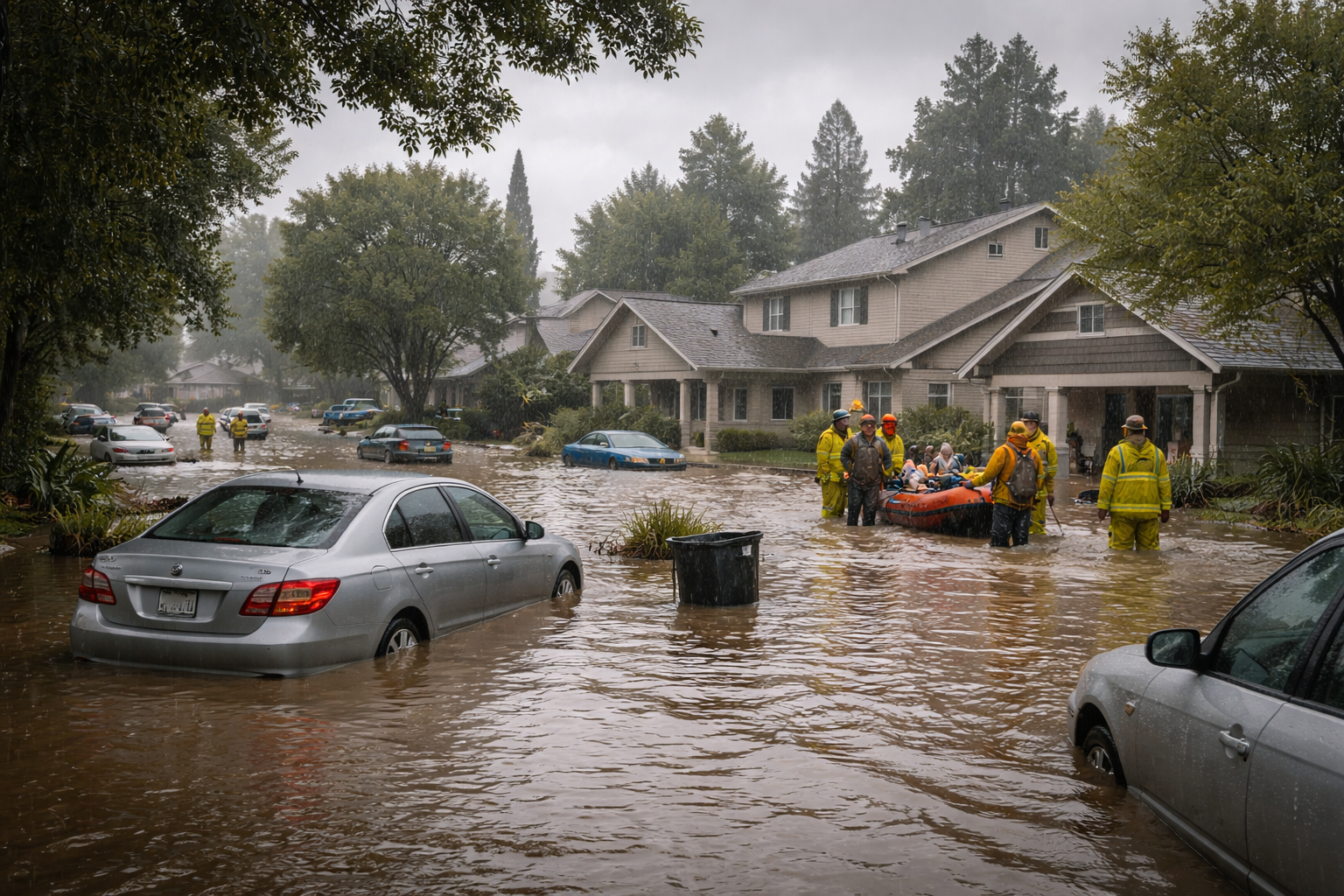
California Weather Update: Flooding, Mudslides, and a State Under Siege
California is currently grappling with a relentless series of atmospheric rivers that have turned a festive holiday season into a fight for survival. Throughout late December 2025, a conveyor belt of moisture from the Pacific has slammed into the West Coast, triggering widespread flooding, catastrophic debris flows, and at least three confirmed deaths. From the submerged lanes of Interstate 5 to the mud-caked streets of mountain resort towns, the state is facing its most significant weather crisis of the year.
The Mechanics of the Deluge
The primary driver of this destruction is a phenomenon known as an atmospheric river—a long, narrow plume of water vapor that carries moisture from the tropics to the higher latitudes. This particular system was so vast that meteorologists tracked its origin nearly 11,000 kilometers away, stretching across the Pacific toward the Philippines.
When this “river in the sky” makes landfall, it releases staggering amounts of precipitation. In Los Angeles County, mountainous areas have recorded more than 11 inches of rain in a single 48-hour window. For a region that typically measures its December rainfall in fractions of an inch, the sheer volume of water has overwhelmed drainage systems and turned quiet creeks into raging torrents.
Death Toll and Human Impact
The human cost of the storm became tragically clear as Christmas Eve approached. In San Diego’s City Heights neighborhood, a 64-year-old man, Roberto Ruiz, was killed when a 75-foot-tall tree collapsed onto him as he attempted to move his car. In Northern California, a Sacramento Sheriff’s Deputy, James Caravallo, lost his life in a weather-related vehicle accident while responding to calls for service.
Beyond the fatalities, the storm has displaced thousands. In Wrightwood, a mountain community northeast of Los Angeles, residents were initially told to shelter in place as mud surged through the town. By Christmas afternoon, that order shifted to a mandatory evacuation. Footage from the scene showed brown, viscous sludge flowing through the porches of homes and burying vehicles up to their wheel wells.
In one instance, a family with a 14-month-old daughter found themselves stranded in a rented cabin with dwindling supplies. They were only saved by the intervention of neighbors who used social media to coordinate a delivery of diapers, milk, and bread through the sludge.
The Burn Scar Factor
The severity of the flooding is not just a result of the rain, but also the scars left behind by California’s previous fire seasons. Wildfires strip hillsides of vegetation and bake the soil into a water-repellent crust. When heavy rain hits these “burn scars”—such as those from the Airport Fire in Orange County or the recent blazes in the San Gabriel Mountains—the water does not soak in. Instead, it picks up ash, rocks, and downed timber, creating a debris flow that moves with the force of wet concrete.
Governor Gavin Newsom has declared a state of emergency in six counties, including Los Angeles and San Bernardino, to fast-track resources. The California National Guard remains on standby, while over 150 firefighters have been permanently stationed in the most vulnerable mountain corridors to conduct swift-water rescues.
Infrastructure and Travel Chaos
The timing of the storm could not have been worse for the millions of Californians traveling for the holidays. Interstate 5, the state’s main north-south artery, saw significant closures near Burbank Airport after water and mud covered the lanes. At Los Angeles International Airport (LAX), hundreds of flights were delayed or canceled as visibility dropped and wind gusts topped 50 mph.
Power outages have also plagued the state. At the peak of the storm on December 25, more than 120,000 customers were without electricity. Crews from the Department of Water and Power have been working through the night, often in treacherous conditions, to restore service to neighborhoods where falling trees have snapped utility lines.
A Pattern of Extremes
This December deluge follows a record-breaking dry spell earlier in the autumn, highlighting California’s increasingly volatile “weather whiplash.” While the rain is helping to replenish the state’s reservoirs and build a much-needed snowpack in the Sierra Nevada—where feet of snow are currently falling—the intensity of the delivery is the problem.
Climate scientists note that while atmospheric rivers are a natural part of California’s ecology, a warming atmosphere can hold more moisture, leading to “super-charged” storms. The 2025 Christmas storm is a definitive example of this trend: it broke a 50-year rainfall record for the holiday in downtown Los Angeles, delivering nearly a month’s worth of rain in less than 48 hours.
Looking Ahead
Forecasters warn that the danger has not yet passed. With the ground now fully saturated, even moderate rainfall in the coming days could trigger new landslides. Flood watches remain in effect for coastal areas like Malibu and much of the Sacramento Valley.
For residents in high-risk zones, the message from officials is blunt: do not wait for the water to reach your door. The speed of these debris flows means that by the time you see the mud, it is often too late to leave. As the state begins the long process of clearing mud from its highways and assessing property damage, the priority remains the safety of those still in the path of the next wave of moisture.