
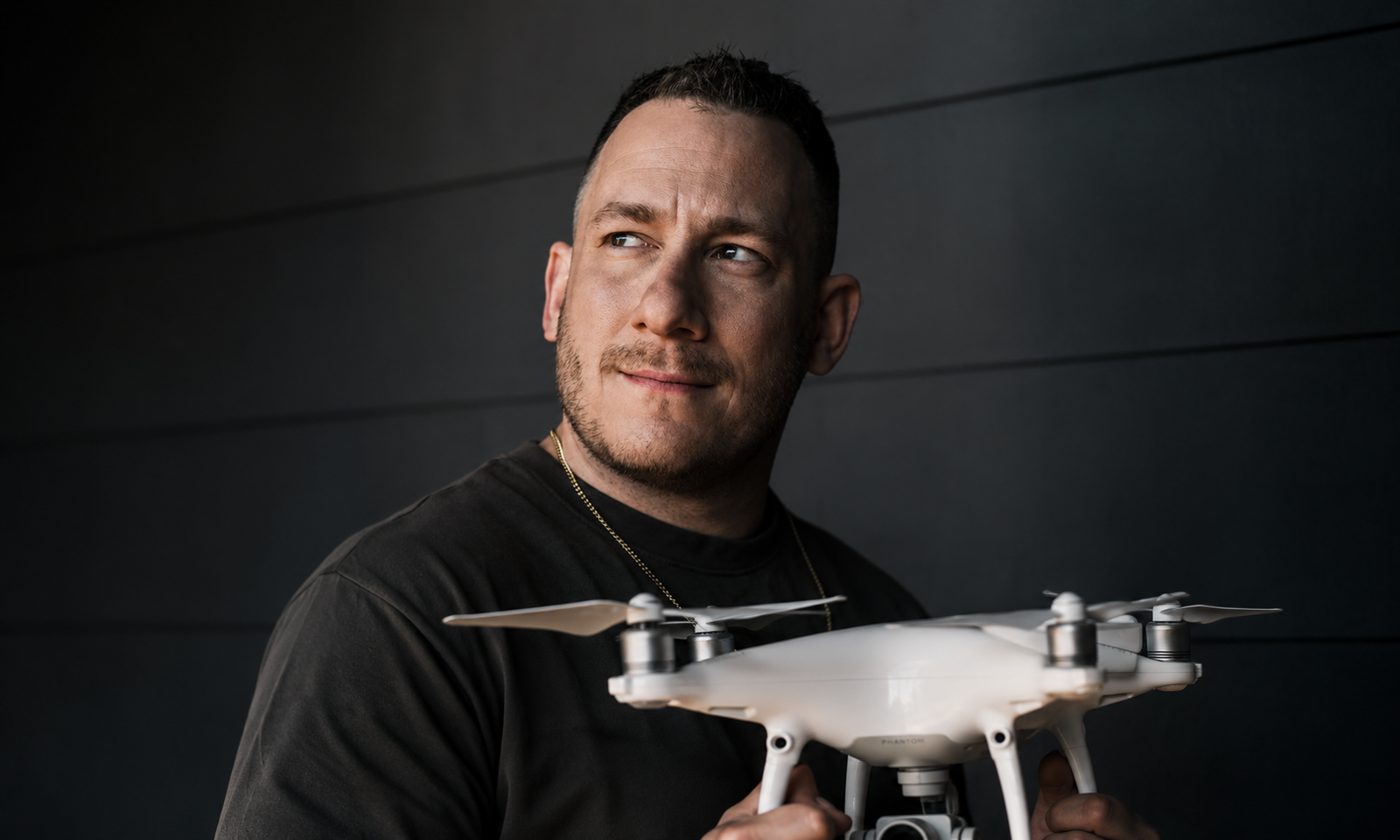
Billboards in the Clouds: Kevin Prince and the New Economics of Aerial Marketing
The entertainment market values attention above everything else. For years, major corporations spent billions of dollars on television commercials and digital banners that consumers paid money to skip. Kevin Prince recognized that the next generation of marketing required creating spectacles that people could not look away from. Leaving a comfortable position as a marketer at Netflix, Prince entered the physical world of robotics and aviation to build a drone light show startup that quickly scaled to three million dollars in revenue.
His transition reveals a fundamental truth about modern business: the technology behind a product matters far less than how you position that product to corporate buyers. Drone shows are frequently viewed as technical marvels or engineering feats, but Prince treated them as massive, unmissable billboards in the night sky. By applying the aggressive storytelling strategies used by major streaming networks to the sky, he turned a complex robotic service into a highly profitable experiential marketing asset.
The Corporate Marketing Blueprint
Working inside the marketing ecosystem at Netflix teaches a person how to manufacture cultural moments. The streaming giant does not merely launch a show; they build viral installations, execute global stunts, and dominate social media conversations. When Prince looked at the emerging drone industry, he did not see a hobby or a simple replacement for traditional fourth of July fireworks. He saw a completely open canvas for high-impact brand storytelling.
Traditional advertising is facing a massive crisis of engagement. Consumers are completely numb to standard digital ads, and physical billboards on highways are easily ignored. A fleet of hundreds of synchronized, glowing drones forming a massive, animated logo two hundred feet in the air is impossible to ignore. People do not just look at a drone show; they pull out their smartphones, record the experience, and immediately upload it to their social media feeds. The brand gets the benefit of the live event, plus millions of impressions from organic, user-generated content.
Prince realized that tech companies and movie studios were willing to pay an incredible premium for this level of viral exposure. He did not pitch his services to small municipal boards looking to save money on fireworks. He went straight to the corporate entities he understood best: entertainment brands, luxury product manufacturers, and major sports leagues. These clients have massive experiential marketing budgets and are constantly hunting for ways to shock their audiences.
The True Costs of Aerial Robotics
Building an inventory of commercial light show drones requires deep capital and a clear understanding of hardware lifecycles. You cannot simply buy standard off-the-shelf camera drones and fly them in a formation. Light show drones are highly specialized, stripped-down quadcopters built for a single purpose: to carry a hyper-bright LED light and follow a precise coordinate path.
| Asset Category | Estimated Initial Expense | Operational Lifecycle |
| Specialized Light Drones | $1,500 to $2,500 per individual unit | Two to three years of active flight time |
| Ground Control Infrastructure | $15,000 per operational team kit | Four years before necessary hardware upgrades |
| Industrial Transport Cases | $400 per multi-unit storage box | Indefinite with basic foam replacements |
| High-Capacity Battery Sets | $200 per individual flight cell | 150 to 200 charging cycles maximum |
Scaling a business to three million dollars in revenue means managing a massive fleet of these aircraft. If a company wants to execute a complex 3D animation, like a rotating car or a moving character, they need a minimum of three hundred drones in the air simultaneously. The upfront capital required to purchase this hardware is a massive barrier to entry. This high cost protects early market leaders from cheap competitors, allowing startups like Prince’s to maintain healthy profit margins once they secure their initial inventory.
The real financial drain in this industry is not the initial purchase of the plastic frames or the motors. The real cost lies in the lithium-ion batteries. These power cells are highly volatile, require continuous climate-controlled storage, and degrade rapidly with every single flight. A company must constantly reinvest their profits into fresh battery inventory to ensure the drones do not lose power mid-show and fall from the sky.
Navigating the Regulatory Minefield
The general public looks at a drone show and sees art, but the federal government looks at a drone show and sees a serious aviation hazard. Operating hundreds of autonomous aircraft in shared airspace requires a level of regulatory compliance that terrifies the average entrepreneur. Prince had to transition from the fast-moving, rule-breaking culture of Silicon Valley marketing to the slow, rigid world of federal aviation law.
The Federal Aviation Administration enforces incredibly strict guidelines under Part 107 rules for commercial drone operations. Under standard laws, a single pilot is only allowed to fly a single drone at one time. To fly hundreds of drones simultaneously with a single operator, a startup must secure a highly specialized collective waiver. Getting this approval requires proving to federal inspectors that your software has multiple layers of redundant safety systems.
[Main Control Computer]
       │
       ├─► [Primary Radio Transmitter] ──► (Real-Time Kinematic GPS Sync)
       │
       └─► [Backup Control Network] ─────► (Automated Emergency Landing System)
If the primary radio communication link drops during a live performance, the drones cannot simply drift into the path of incoming passenger aircraft. The ground control software must constantly broadcast a heartbeat signal to every unit. If that signal breaks for even a few seconds, the onboard computers must automatically trigger an emergency procedure. The drones will immediately stop their animation, dim their lights, and descend slowly to a pre-determined, secured landing zone on the ground.
Security parameters also include strict geofencing protocols. Before the first motor spins, engineers program a digital wall around the flight area. If a sudden gust of wind pushes a drone outside this invisible boundary, the aircraft instantly shuts down its performance tracking and drops straight down within the safe zone rather than risking a flyaway scenario into a populated crowd.
Moving From Animation to Flight Paths
The process of creating a drone show is a complex translation of digital art into physical coordinates. It begins in traditional 3D animation software like Blender or Maya, where digital artists build a moving model of the client’s logo or character. The artist does not think about wind, gravity, or battery life; they focus entirely on the visual impact of the design.
Once the client approves the creative concept, the file is passed to a specialized flight path engineer. This engineer runs the animation through a proprietary software program that assigns every individual pixel of light to a specific drone in the fleet. The software calculates the exact mathematical trajectory for every single aircraft, ensuring that no two drones ever occupy the same physical space at the same time.
Step 1: Creative Art Asset ──► Built by 3D designers in standard animation software
Step 2: Trajectory Compiling ─► Specialized software calculates individual flight paths
Step 3: Collision Mitigation ──► Safety algorithms verify a safe distance between units
Step 4: Real-World Upload ────► Flight coordinates are beamed directly to the fleet
This stage requires solving intense mathematical problems regarding physical spacing. Drones create a massive amount of downward wind, known as prop wash, when they fly. If one drone flies directly underneath another unit too closely, the turbulent air will cause the lower drone to lose stability and crash. The software must constantly analyze the flight paths to ensure that every drone maintains a safe buffer zone from its neighbors in three-dimensional space.
The accuracy of these formations relies on Real-Time Kinematic GPS technology. Standard satellite navigation on your smartphone is only accurate to within a few meters, which is far too imprecise for a coordinated light show. By utilizing a local ground station that calculates atmospheric signal distortion in real time, the startup can pinpoint the location of every drone down to a single centimeter. This extreme precision allows artists to create crisp, razor-sharp lines and complex overlapping textures in the sky.
The Logistical Nightmare of Moving Fleets
Winning a client contract is easy compared to the physical reality of moving thousands of pounds of highly regulated equipment across the country. A single three-hundred-drone show requires a massive logistical footprint, including trucks, generators, specialized cases, and a highly trained crew of field technicians.
Because lithium-ion batteries are considered hazardous materials, they cannot be shipped on commercial passenger airlines in large quantities. If Prince’s company books a major corporate activation in another state, the equipment must travel via specialized ground transportation or cargo carriers that follow strict safety mandates. The trucks must be climate-controlled to prevent the batteries from overheating during long drives across desert states.
Once the team arrives at the event venue, the setup process is exhausting and highly repetitive:
-
The crew must manually lay out massive grid mats across a flat field, ensuring the surface is clear of tall grass or debris that could catch in the propellers.
-
Every single drone must be carefully unpacked from its protective foam slot and placed on its designated grid coordinate.
-
Technicians must manually insert a freshly charged battery pack into every aircraft and verify that the firmware is synchronized with the master control computer.
-
The flight team must run individual diagnostic checks on the radio receivers, the LED arrays, and the GPS sensors before receiving clearance to launch.
This setup process can take an entire afternoon for a show that ultimately lasts only ten to twelve minutes. If a single drone fails its pre-flight diagnostic check, a technician must run onto the field, replace the unit, and re-verify the network balance before the strictly timed countdown clock hits zero.
The Business Strategy That Enabled Scale
Many drone companies fail because they try to serve everyone. They buy fifty drones and chase local fairs, music festivals, and private weddings. Prince took the opposite stance, focusing exclusively on high-margin enterprise clients. He understood that a corporate brand is not looking for a cheap option; they are looking for absolute reliability and massive public relations impact.
A tech corporation launching a new product will happily pay seventy-five thousand dollars for a ten-minute custom drone show if it guarantees their brand trends on social media the next morning. A local city council operating on tax dollars will argue over a ten-thousand-dollar fireworks budget. By positioning his startup as a premium experiential marketing agency rather than a technical fireworks alternative, Prince unlocked the cash flow necessary to fund his rapid hardware expansion.
This corporate focus also protects the business during seasonal economic shifts. Traditional fireworks businesses generate almost all of their revenue during a single week in July and around New Year’s Eve. Corporate product launches, tech conferences, and major movie premieres happen every single week of the year. This steady stream of enterprise contracts provides predictable, year-round revenue that allows the startup to maintain full-time staff and invest heavily in continuous software development.
The End of Traditional Pyrotechnics
The long-term growth of the drone entertainment industry is heavily supported by an ongoing cultural shift against traditional fireworks. For decades, exploding chemical shells were the only option for large-scale night entertainment. Today, municipalities and private venues face immense pressure to abandon pyrotechnics entirely due to environmental and community concerns.
Fireworks release massive amounts of particulate matter and toxic chemical residues into local water supplies and ecosystems. They create intense sound pollution that triggers severe anxiety in domestic pets, local wildlife, and military veterans suffering from traumatic stress. Furthermore, as climate change increases the frequency and severity of summer droughts across the United States, municipal leaders are becoming terrified of launching burning chemical embers over dry brushland.
Drone shows solve every single one of these structural liabilities. They are completely silent, produce zero direct chemical emissions, and carry absolutely no fire risk. A venue can run a drone show in the middle of a severe drought without needing a fleet of fire trucks standing by on the ground. As local governments continue to pass strict bans on consumer and professional fireworks, the market demand for autonomous light shows will inevitably experience a massive, permanent surge.
The Creative Frontiers of 2026
The drone industry in 2026 is moving far beyond the simple, static two-dimensional shapes that defined its early years. The current market demands hyper-realistic three-dimensional animations that tell complex stories across multiple acts. Founders like Prince are now integrating secondary technologies like pyrotechnic attachments, onboard smoke machines, and synchronized ground audio to create massive multimedia experiences.
We are also seeing the introduction of much smaller, lighter aircraft constructed from advanced carbon fiber composites. These next-generation drones can fly closer together without risking prop-wash accidents, enabling much higher visual resolution in the sky. Instead of a blocky, low-polygon logo, modern fleets can render smooth, organic human faces and complex fluid dynamics against the stars.
The true competitive battleground of this industry has shifted entirely from the hardware to the software. The companies that build the most efficient trajectory compilation algorithms and the most reliable radio communication networks will dominate the market. Kevin Prince proved that an outsider with a deep understanding of corporate psychology can enter a highly technical field, ignore the hobbyist market, and build a multi-million dollar enterprise by simply turning the sky into the ultimate storytelling medium.