
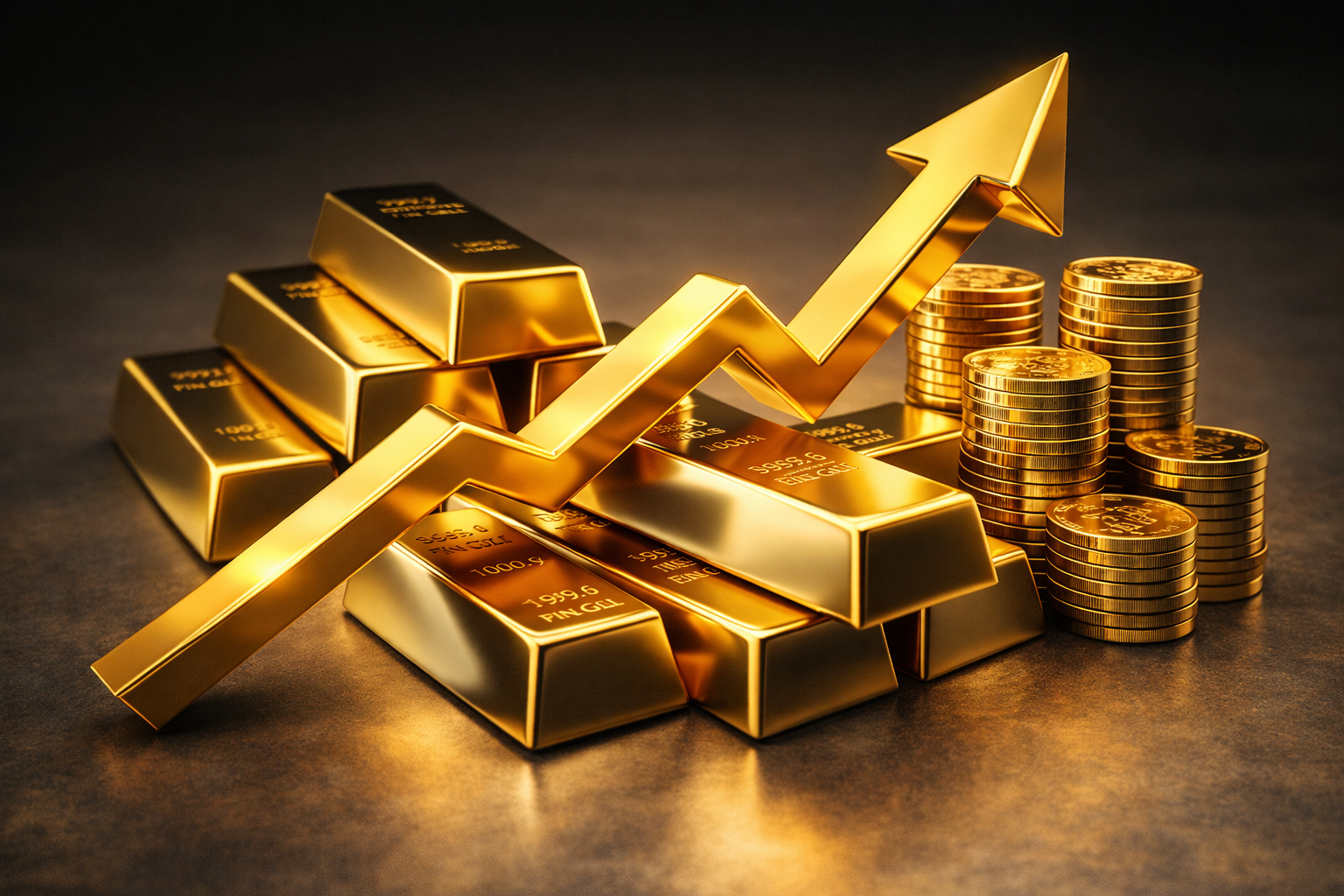
The Race to $5,000: Why Gold and Silver Are Just Getting Started
The number on the screen isn’t just a price; it’s a verdict. For years, the $5,000 per ounce mark for gold felt like a moonshot—a figure tossed around by doomsday preppers and hyper-bullish newsletter writers. But as we settle into January 2026, with spot prices already testing the $4,800 threshold, that moonshot has become a mathematical inevitability.
We aren’t watching a standard market cycle. We are witnessing a fundamental repricing of trust. When you walk into a coin shop today—if you can find one with inventory—the mood isn’t excitement. It’s validation. The long-term holders aren’t selling; they are buying the dips, and the reasons go far beyond simple inflation.
This is the state of the metal market in 2026.
Why Is Gold Increasing? The “Perfect Storm” Thesis
To understand why we are knocking on the door of $5,000, you have to look at the three distinct engines firing all at once.
1. The Central Bank Pivot
For decades, Western investors set the price of gold. If Wall Street bought ETFs, gold went up. If they sold, it crashed. That dynamic is dead. The primary driver of gold today is the “sovereign buyer”—specifically central banks in the East. China, India, and smaller emerging economies have stopped treating US Treasuries as the ultimate safe asset. They are aggressively diversifying into physical gold. They aren’t trading for profit; they are accumulating for survival. They don’t care about the daily chart; they care about owning an asset that no other country can freeze or sanction.
2. The Trump Tariff Effect
Since Donald Trump’s return to the White House, the economic playbook has shifted toward aggressive protectionism.1 The tariffs launched in April 2025 created immediate friction in global trade. Tariffs are inflationary by nature—they raise the cost of goods. When you combine higher consumer prices with the administration’s vocal criticism of the Federal Reserve’s independence, the market smells uncertainty. Gold feeds on uncertainty. It doesn’t pay interest, but it doesn’t default, and it doesn’t care who the Fed Chair is.
3. The Debt Spiral
We can’t ignore the math. The US national debt isn’t shrinking. The interest payments alone now consume a massive chunk of the federal budget. The market has realized that there are only two ways out of this debt trap: default (impossible) or inflate the currency until the debt looks smaller (inevitable). Gold is simply measuring the devaluation of the dollar in real-time.
The Silver Forecast: The Industrial Giant Wakes Up
If gold is the wealth shield, silver is the workhorse. And the workhorse is exhausted.
For years, silver languished around $25 an ounce. Now, with forecasts from major brokerages like Peel Hunt upgrading their 2026 targets to $75 per ounce, the dynamic has flipped. The issue with silver is that it is burning the candle at both ends.
The “Double Whammy” Demand
Silver is facing a unique crisis. On one side, you have investment demand—people buying coins because gold is too expensive. On the other side, you have the “Industrial Squeeze.”
Solar Power: The transition to green energy is non-negotiable for many nations. Modern solar panels (especially the newer, more efficient TOPCon cells) use significantly more silver than previous generations.
AI Hardware: This is the silent killer of silver supply. We talk about AI in terms of software, but AI lives on chips. High-performance computing, servers, and the complex circuitry driving the AI boom require massive amounts of conductive material. Silver is the most conductive metal on earth. You cannot build the future without it.
We are entering a structural deficit. We are consuming more silver than we mine, and the above-ground stockpiles are draining. $50 silver was a psychological barrier; $75 is now a fundamental target based on sheer scarcity.
Trump vs. Gold: A Complicated Relationship
President Trump’s influence on gold is paradoxical.
On paper, a “strong America” policy usually boosts the dollar, which hurts gold. However, his specific policies—high tariffs, deficit spending, and pressure on the Fed to lower rates—are rocket fuel for precious metals.
The market fears that political pressure will force the Fed to cut rates even if inflation stays hot. If interest rates are lower than the inflation rate, your cash loses value every day it sits in the bank. That is called “negative real rates,” and it is the single best environment for gold prices. The administration’s focus on a weaker dollar to boost exports further incentivizes foreign nations to dump dollars and buy gold.
Elon Musk: Digital Energy vs. The Old Guard
Elon Musk has been a wildcard in the metals narrative. In late 2025, he reignited the debate by agreeing that fiat currency is “fake” and praising Bitcoin as “energy-based” money.
Musk’s stance highlights a generational divide that is actually helping gold.
The Crypto Camp: Sees Bitcoin as “Digital Gold”—portable, verifiable, and scarce.
The Gold Camp: Sees Gold as “Analog Bitcoin”—proven over 5,000 years, no electricity required.
Interestingly, these two assets have stopped fighting each other. In 2026, they are moving in tandem against the dollar. When Musk tweets about the “debasement of currency,” he drives interest to all hard assets. He might prefer the digital version, but his logic validates the physical one too. Institutional investors who find crypto too volatile are taking Musk’s thesis and applying it to gold.
The Tech Demand: Gold in the Machine
We often think of gold as jewelry or bars in a vault. We forget that gold is a functional industrial metal.
Gold never corrodes. It is the ultimate connector. In the world of AI chips and quantum computing, failure is not an option. You cannot use cheap copper connectors in a $50,000 server blade that runs at 200 degrees. You use gold.
As the AI arms race heats up, tech companies are securing their supply chains. They aren’t just buying chips; they are buying the raw materials. This “strategic technology metal” status adds a floor to the price. Even if investors stop buying, Apple, NVIDIA, and Google still need the metal to operate.
Historical Perspective: The 25-Year Chart
To see where we are going, look at the last 25 years.
2000-2011: Gold ran from $250 to $1,900. This was the “fear trade” driven by 9/11, the 2008 crash, and quantitative easing.
2011-2015: The correction. Prices fell back to $1,050. People called it a “pet rock.”
2016-2019: The boring years. Sideways grinding.
2020-2024: The breakout. COVID-19 stimulus and inflation pushed us past $2,000, then $2,500.
2025-2026: The acceleration. We broke $3,000, then $4,000, and now we sit near $4,800.
The chart shows a “stair-step” pattern. We are currently in a vertical aggressive phase. These phases can last for years, but they are volatile. The $5,000 target is simply the next psychological round number in a trend that started in 2001.
The Strategy: Buy, Wait, or Fold?
So, is it too late?
The Case for Buying Now
If you believe the US government will solve its debt crisis and stop printing money, do not buy gold. If you believe the deficits will continue and inflation is structural, $4,800 will look cheap in five years. Goldman Sachs raising their target to $5,400 suggests that the “smart money” is still positioning for upside.
The Case for Waiting
No asset goes up in a straight line. Gold is currently “overbought” on the technical charts. A pullback to the $4,500 range is possible and arguably healthy. If you are a trader, you wait for the dip.
Gold or Silver?
Buy Gold if you want wealth preservation. It is less volatile. It is the savings account of the rich.
Buy Silver if you want aggressive growth. Silver is explosive. It can drop 10% in a week, but it can also double in a year if the industrial shortage hits hard.
How Long to Hold?
This is not a flip. You don’t buy gold to sell it next Tuesday. You buy it to hold until the macroeconomic landscape changes. Given the current debt cycle, the suggested holding period is 3 to 5 years minimum.
A Concrete Verdict
We are living through a historic rotation of capital. The money is moving from paper assets to hard assets.
Gold at $5,000 is not a bubble; it is a repricing of the dollar. The train has left the station, but it hasn’t reached the destination. If you are sitting on the sidelines hoping for $2,000 gold to return, you might be waiting for a world that no longer exists.
Next Step for You:
Would you like me to analyze the specific tax implications of selling gold in your region, or should we look at a comparison of the top Gold ETFs vs. Physical Gold dealers for 2026?